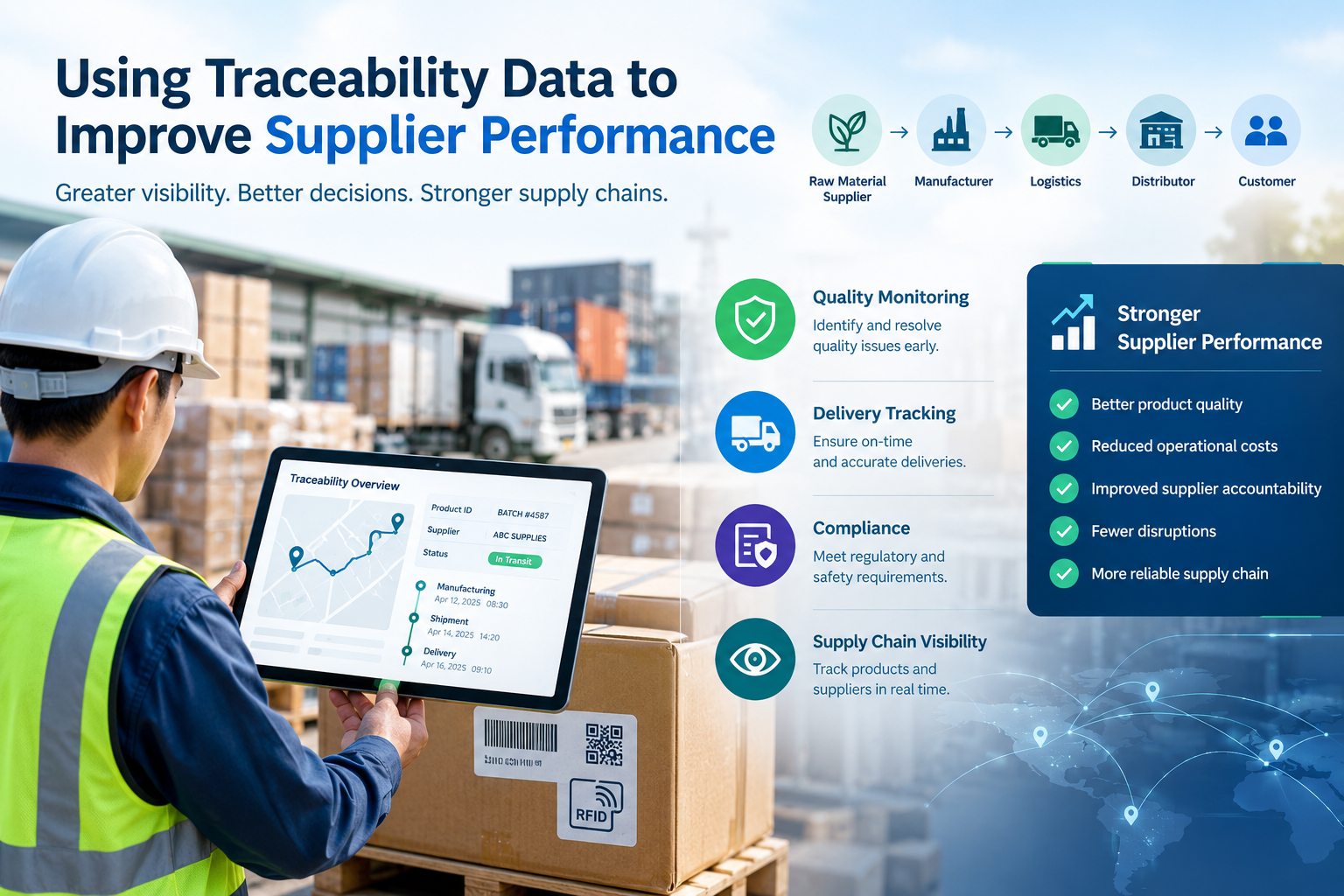
• Using Traceability Data to Improve Supplier Performance

    Using Traceability Data to Improve Supplier Performance

    Using Traceability Data to Improve Supplier Performance

    In today’s competitive business environment, supplier performance plays an important role in maintaining product quality, reducing operational costs, and ensuring timely deliveries. Businesses need accurate information about their suppliers to make better decisions and manage supply chain operations effectively. This is where traceability data becomes valuable.

    Traceability data helps businesses track products, materials, shipments, and supplier activities throughout the supply chain. By analyzing this information, companies can identify performance issues, monitor delivery timelines, improve product quality, and build stronger relationships with suppliers.

    In this blog, we will explore how traceability data for supplier performance can help businesses improve supply chain visibility, measure supplier efficiency, and make data-driven decisions.

    Introduction to Traceability Data and Supplier Performance

    Traceability data refers to information collected throughout a product’s journey, from raw material sourcing to manufacturing, transportation, and final delivery. This information helps businesses understand where products come from, how they move through the supply chain, and whether suppliers meet expected standards.

    Supplier performance refers to how effectively a supplier delivers materials or services according to agreed requirements, including quality, cost, delivery time, and compliance.

    When businesses combine traceability data with supplier performance monitoring, they gain better visibility into supplier activities and can identify areas that require improvement.

    What Is Traceability Data?

    Traceability data includes information such as product origin, batch numbers, manufacturing dates, shipment details, inventory movements, and delivery records.

    Businesses can collect this information using technologies such as RFID tags, barcodes, QR codes, Internet of Things (IoT) sensors, and supply chain management software.

    For example, a manufacturer can use traceability data to identify which supplier provided a defective component and determine which products may have been affected.

    Why Is Supplier Performance Important?

    Reliable suppliers help businesses maintain consistent quality, prevent production delays, and meet customer expectations. Poor supplier performance can lead to defective products, increased costs, missed deadlines, and customer dissatisfaction.

    Monitoring supplier performance allows businesses to identify problems early, evaluate suppliers objectively, and make informed decisions about future partnerships.

    How Traceability Data Helps Improve Supplier Performance

    Traceability data provides businesses with detailed information about supplier activities and supply chain operations. This information can be used to measure performance, identify risks, and improve operational efficiency.

    Improving Product Quality and Consistency

    Product quality is one of the most important factors when evaluating suppliers. Traceability data helps businesses track raw materials, production batches, inspection records, and quality issues.

    If a business identifies repeated defects associated with a particular supplier or batch, it can investigate the source of the problem and take corrective action.

    This approach helps reduce waste, improve quality control, and maintain consistent product standards.

    Monitoring Supplier Delivery Times

    Late deliveries can interrupt manufacturing schedules, create inventory shortages, and affect customer satisfaction.

    By tracking shipment dates, dispatch records, estimated arrival times, and actual delivery times, businesses can measure whether suppliers consistently meet their deadlines.

    This information helps identify recurring delays and supports discussions with suppliers about improving delivery performance.

    Identifying Supply Chain Bottlenecks

    Supply chain bottlenecks can occur during manufacturing, packaging, transportation, or warehouse operations.

    Traceability data helps businesses identify where delays occur and determine whether they are related to supplier processes, transportation issues, or inventory management.

    Once the cause is identified, businesses can take targeted action to reduce delays and improve the overall flow of materials.

    Improving Supplier Compliance and Accountability

    Businesses often need suppliers to meet specific quality, safety, documentation, and regulatory requirements.

    Traceability records can provide evidence of product origin, batch movement, inspection results, and other relevant activities. These records make it easier to review supplier compliance and investigate discrepancies.

    Clear and accessible records also improve accountability by helping businesses understand what happened, when it happened, and where corrective action may be needed.

    Key Supplier Performance Metrics to Track

    To improve supplier performance, businesses should monitor measurable indicators rather than rely only on assumptions or occasional reviews.

    On-Time Delivery Rate

    The on-time delivery rate measures the percentage of orders delivered by the agreed deadline.

    Formula:

    On-Time Delivery Rate = (Orders Delivered on Time ÷ Total Orders Delivered) × 100

    For example, if a supplier delivers 90 out of 100 orders on time, the on-time delivery rate is 90%.

    Businesses can use this metric to compare supplier reliability and identify recurring delivery problems.

    Defect Rate and Product Quality

    The defect rate measures the proportion of supplied products or components that fail to meet quality requirements.

    Formula:

    Defect Rate = (Defective Units ÷ Total Units Received) × 100

    A lower defect rate generally indicates better product quality. However, businesses should also consider defect severity, inspection methods, and product-specific quality standards.

    Order Accuracy and Lead Time

    Order accuracy measures whether suppliers deliver the correct products, quantities, and specifications.

    Lead time measures the time between placing an order and receiving the goods.

    Traceability records help businesses identify incorrect shipments, measure delivery timelines, and determine whether suppliers consistently meet agreed requirements.

    Supplier Compliance Rate

    The supplier compliance rate measures the proportion of applicable requirements a supplier meets.

    Depending on the business, these requirements may include documentation, quality standards, safety procedures, and delivery conditions.

    Monitoring compliance helps businesses identify gaps and ensure that suppliers follow the necessary processes.

    Technologies Used to Collect and Analyze Traceability Data

    Modern technologies make it easier to collect, organize, and analyze supply chain information. The right solution depends on the products, industry, operational requirements, and level of tracking needed.

    RFID and Barcode Tracking

    Radio Frequency Identification (RFID) uses radio waves to identify tagged items, while barcodes store information that can be read using an appropriate scanner.

    These technologies help businesses record product movements, monitor inventory, track shipments, and maintain more accurate records.

    For example, RFID can help a warehouse identify tagged inventory as it moves through designated reading points, while barcode scanning can record items during receiving and dispatch.

    IoT Sensors and Real-Time Monitoring

    IoT sensors can collect information such as temperature, humidity, location, and movement, depending on the device and its capabilities.

    This information is especially useful when suppliers transport products that require controlled environmental conditions, such as certain food items, medicines, or sensitive materials.

    Businesses can use sensor data to identify potential problems during transportation and investigate whether handling conditions met the required standards.

    Supply Chain Analytics and Dashboards

    Supply chain analytics tools transform traceability records into reports, dashboards, and performance indicators.

    A dashboard can display delivery performance, defect rates, shipment delays, supplier compliance, and other important metrics.

    By reviewing this information regularly, managers can compare supplier performance, identify trends, and prioritize improvement activities.

    Best Practices for Using Traceability Data Effectively

    Collecting traceability data is only the first step. Businesses must also ensure that the information is accurate, accessible, and connected to clear performance goals.

    Set Clear Supplier Performance Goals

    Businesses should define measurable expectations for delivery times, product quality, order accuracy, and compliance.

    These targets should reflect business requirements and be communicated clearly to suppliers. Consistent measurement helps companies evaluate performance fairly and identify suppliers who need additional support.

    Review Data Regularly and Share Feedback

    Supplier performance should be reviewed at appropriate intervals based on business needs and supply chain risks.

    Regular reviews help businesses recognize recurring issues, evaluate improvement efforts, and discuss performance results with suppliers.

    Sharing accurate data with suppliers also encourages transparency and makes it easier to agree on corrective actions.

    Use Data to Support Supplier Collaboration

    Traceability data should not be used only to identify mistakes. It can also help businesses and suppliers work together to improve processes.

    For example, if shipment records show repeated delays at a particular stage, both parties can investigate the cause and develop a practical solution.

    This collaborative approach can strengthen supplier relationships and support long-term improvements.

    Challenges in Using Traceability Data

    Although traceability data provides valuable insights, businesses may face challenges when collecting and managing information across multiple suppliers.

    Incomplete or Inaccurate Supplier Data

    Missing records, incorrect product details, and inconsistent data formats can affect the reliability of performance reports.

    Businesses should establish clear data collection standards, validate important records, and encourage suppliers to provide accurate information.

    Integration With Existing Systems

    Suppliers may use different software platforms, inventory systems, and tracking technologies. Connecting these systems can require technical resources and careful planning.

    Businesses should evaluate system compatibility, data exchange requirements, and integration costs before implementing a traceability solution.

    Data Security and Supplier Adoption

    Sharing supply chain information requires appropriate access controls and data protection practices.

    Some suppliers may also be reluctant to adopt new technologies because of cost, training requirements, or changes to existing workflows.

    Businesses can address these challenges through clear communication, suitable training, defined data-sharing policies, and phased implementation.

    Benefits of Data-Driven Supplier Performance Management

    Using traceability data effectively can provide several operational benefits.

    • Better product quality: Identify defects and investigate their sources more quickly.
    • Improved delivery reliability: Monitor shipment timelines and detect recurring delays.
    • Greater supply chain visibility: Understand product movements and supplier activities.
    • Reduced operational costs: Identify avoidable waste, errors, and process inefficiencies.
    • Stronger supplier relationships: Use reliable performance information to support constructive discussions.
    • Improved risk management: Identify potential supply chain problems and take corrective action.
    • More informed decisions: Compare suppliers using consistent, measurable performance indicators.

    The results depend on data quality, implementation, supplier participation, and how effectively businesses use the information they collect.

    Conclusion

    Traceability data is an important resource for businesses seeking to improve supplier performance and strengthen supply chain management. By tracking product movements, delivery records, quality information, and supplier compliance, organizations can identify problems and make better operational decisions.

    Technologies such as RFID, barcodes, IoT sensors, and supply chain analytics help businesses collect and analyze the information needed to monitor supplier activities.

    However, successful implementation requires accurate data, clear performance targets, regular reviews, and collaboration between businesses and their suppliers.

    By adopting a data-driven approach, businesses can improve supplier accountability, reduce operational inefficiencies, and build a more transparent and reliable supply chain.

    Frequently Asked Questions (FAQs)

    1. How Does Traceability Data Improve Supplier Performance?

    Traceability data helps businesses monitor product quality, delivery timelines, order accuracy, and supplier compliance. It allows them to identify performance issues, investigate their causes, and take corrective action.

    2. What Supplier Performance Metrics Should Businesses Track?

    Important metrics include on-time delivery rate, defect rate, order accuracy, lead time, supplier compliance, and cost performance. The most relevant metrics depend on business objectives and supplier responsibilities.

    3. How Do RFID and IoT Improve Supplier Traceability?

    RFID helps identify and track tagged products, while IoT sensors can collect information such as location, temperature, and humidity. Together with suitable software, these technologies can improve supply chain visibility and support supplier performance monitoring.

    4. What Are the Main Challenges of Supplier Performance Tracking?

    Common challenges include inaccurate data, disconnected systems, inconsistent reporting, data security concerns, and limited supplier participation. Clear standards and appropriate technology can help address these problems.

    5. Can Small Businesses Benefit From Traceability Data?

    Yes. Small businesses can start with basic barcode tracking, digital records, and simple supplier performance reports. They can adopt more advanced technologies as their operations and requirements grow.
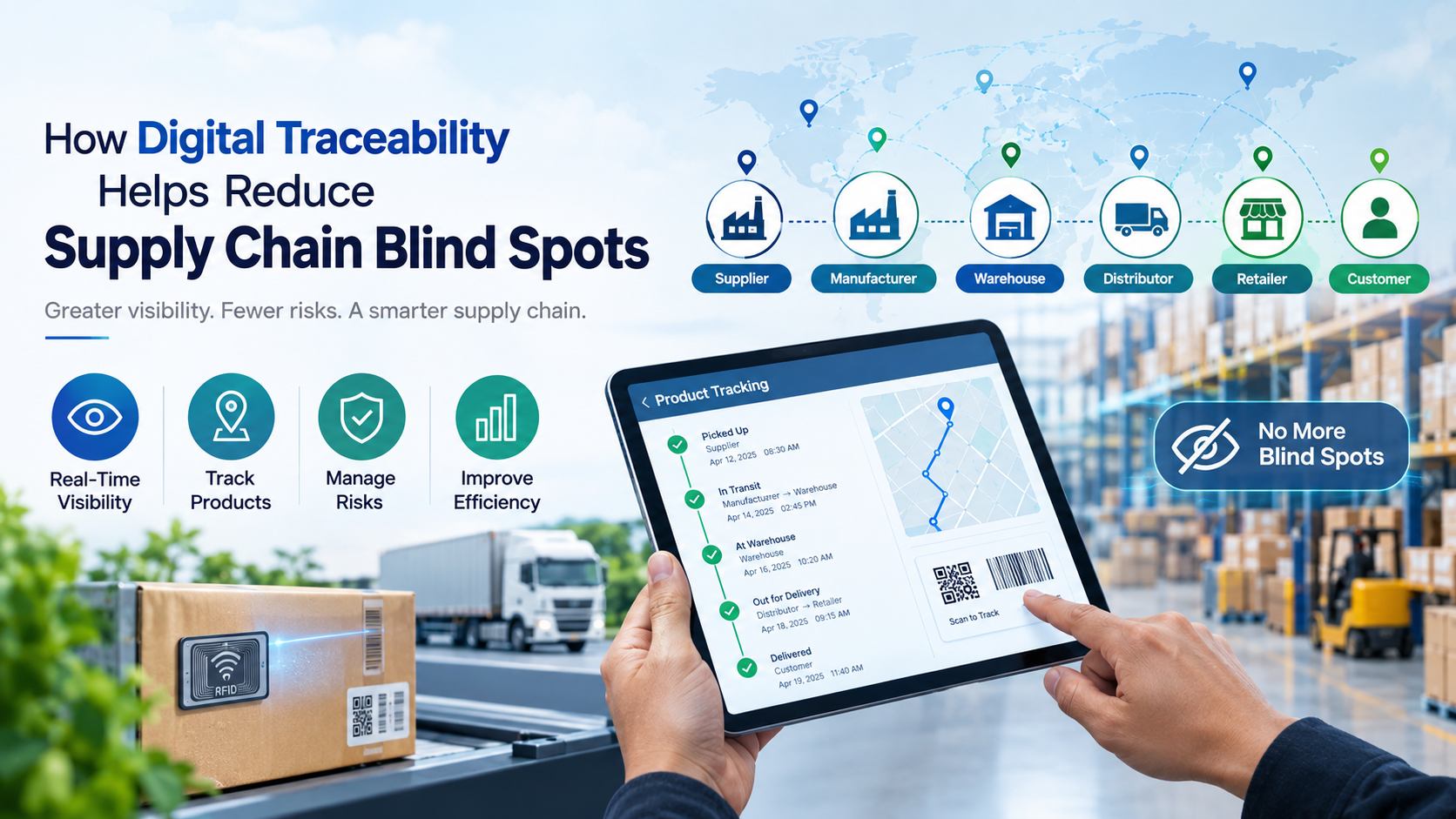
  • How Digital Traceability Helps Reduce Supply Chain Blind Spots

    How Digital Traceability Helps Reduce Supply Chain Blind Spots

    How Digital Traceability Helps Reduce Supply Chain Blind Spots

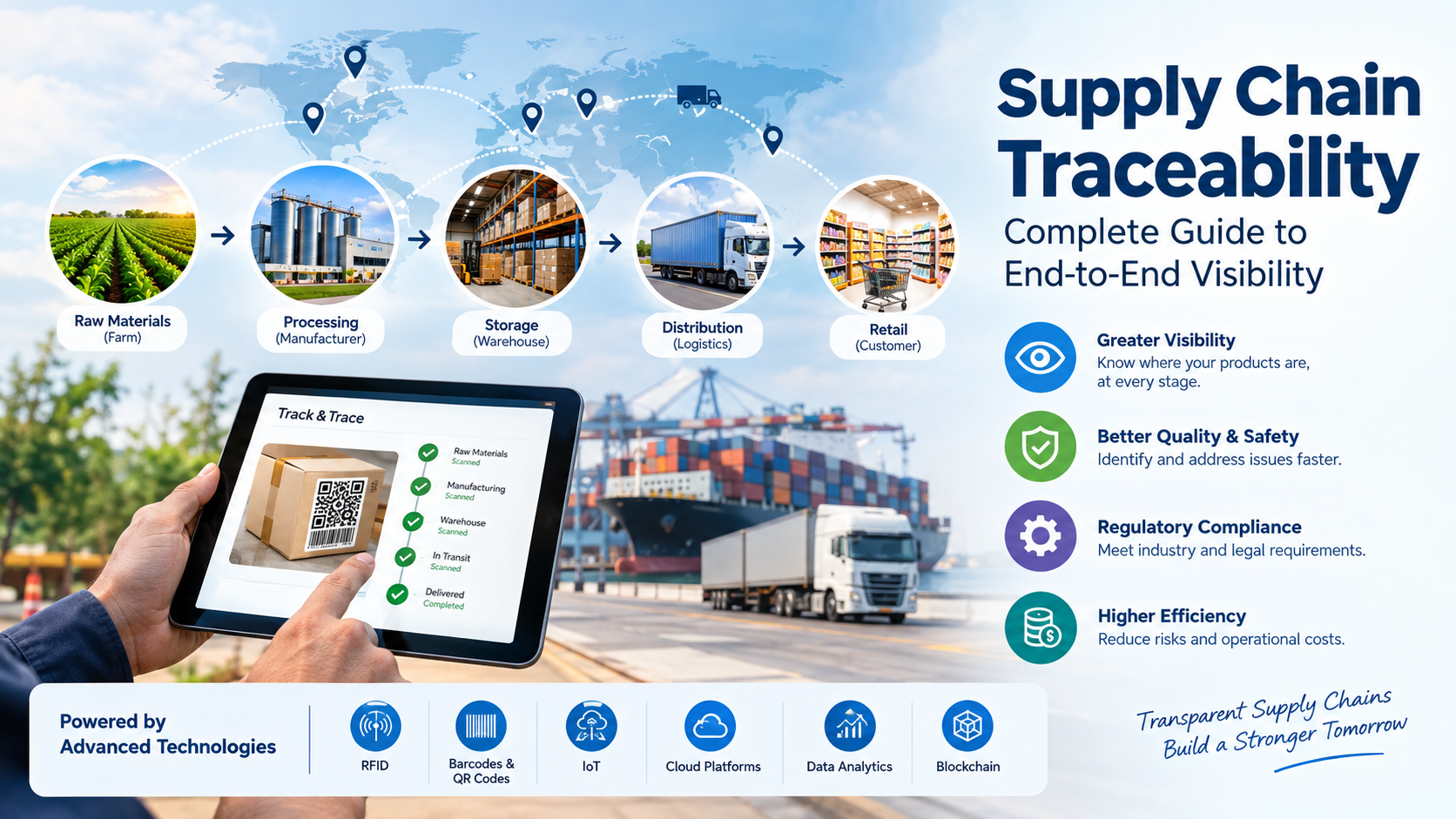
    Modern supply chains involve multiple suppliers, manufacturers, warehouses, distributors, logistics providers, and customers. With so many moving parts, businesses can easily lose visibility into what is happening at different stages of the supply chain. These gaps in visibility are commonly known as supply chain blind spots.

    Digital supply chain traceability helps businesses reduce these blind spots by providing better visibility into products, materials, inventory, shipments, and processes. Using technologies such as RFID, barcodes, IoT, cloud platforms, and data analytics, organizations can track products and access important supply chain information in near real time.

    What Is Digital Supply Chain Traceability?

    Digital supply chain traceability is the process of digitally tracking and recording the movement of products, materials, and information throughout the supply chain.

    Instead of relying on manual records or disconnected systems, businesses can use digital technologies to create a connected view of supply chain activities. This makes it easier to understand where a product came from, where it is currently located, and what happened to it at different stages.

    How Digital Traceability Works

    Digital traceability connects different stages of the supply chain and collects information as products move through them.

    For example, a product may be:

    1. Sourced from a supplier
    2. Sent to a manufacturing facility
    3. Stored in a warehouse
    4. Transported to a distributor
    5. Delivered to a retailer
    6. Purchased by a customer

    At each stage, digital systems can capture relevant information such as location, quantity, status, movement, and timestamps.

    Key Technologies Behind Digital Traceability

    Several technologies can support digital traceability, including:

    • RFID tags and readers
    • Barcodes and QR codes
    • IoT sensors
    • GPS tracking
    • Cloud-based platforms
    • Enterprise resource planning systems
    • Artificial intelligence and analytics
    • Warehouse management systems

    Together, these technologies help businesses create a more connected and transparent supply chain.

    What Are Supply Chain Blind Spots?

    Supply chain blind spots are areas where businesses have limited or no visibility into supply chain activities.

    A company may know that an order was shipped but may not know exactly where it is, why it has been delayed, or whether the shipment was handled correctly. Similarly, a manufacturer may know how much inventory is available in its warehouse but have limited visibility into supplier inventory.

    Common Causes of Supply Chain Blind Spots

    Some common causes include:

    • Manual data entry
    • Disconnected software systems
    • Limited supplier visibility
    • Lack of real-time tracking
    • Poor inventory management
    • Communication gaps
    • Inaccurate or outdated information
    • Complex multi-tier supplier networks

    These problems become more serious when businesses operate across multiple locations and work with numerous suppliers and logistics partners.

    How Blind Spots Affect Supply Chain Performance

    Supply chain blind spots can lead to delayed deliveries, inventory shortages, excess stock, higher operating costs, compliance problems, and poor customer experiences.

    When businesses cannot see what is happening, they often react to problems after they occur instead of identifying and addressing them early.

    How Digital Traceability Reduces Supply Chain Blind Spots

    Digital supply chain traceability provides businesses with better visibility across different stages of their operations.

    Instead of depending entirely on manual updates, companies can collect and share data digitally.

    Improves Real-Time Supply Chain Visibility

    One of the biggest advantages of digital traceability is improved visibility.

    Businesses can monitor the movement and status of products, shipments, and inventory using connected systems. This allows supply chain teams to identify potential issues sooner and make better decisions.

    Tracks Products Across the Supply Chain

    Digital identification technologies such as RFID, barcodes, and QR codes can help businesses track products from one location to another.

    This creates a digital record of product movement and makes it easier to determine where an item is and where it has been.

    Identifies Delays and Disruptions

    Digital traceability can help businesses identify unusual delays, shipment problems, inventory discrepancies, and other disruptions.

    For example, if a shipment remains at a particular location longer than expected, the business can investigate the issue rather than waiting until the customer reports a late delivery.

    Improves Supplier and Inventory Visibility

    Supplier-related blind spots can create major challenges for manufacturers and retailers.

    Digital systems can provide better visibility into supplier orders, inventory levels, product movement, and delivery status. This helps organizations make more informed purchasing and production decisions.

    Enables Faster Problem Resolution

    When a problem occurs, traceability data can help businesses identify where the issue started.

    For example, if a product batch has a quality problem, a company can use traceability records to identify the relevant batch, supplier, production stage, or distribution point. This can make investigations and corrective actions faster.

    Key Benefits of Digital Supply Chain Traceability

    Implementing digital traceability can provide several benefits beyond basic tracking.

    Better Supply Chain Visibility

    Businesses gain a clearer view of products, inventory, shipments, suppliers, and operations.

    Improved Operational Efficiency

    Automated data collection reduces the need for repetitive manual processes and can help employees spend more time on higher-value activities.

    Reduced Supply Chain Risks

    Better visibility allows companies to identify potential disruptions and take action earlier.

    Better Compliance and Product Tracking

    Many industries require organizations to maintain accurate records about products and their movement. Digital traceability can help businesses maintain more reliable records and support compliance requirements.

    Improved Customer Trust

    Customers increasingly want information about where products come from and how they move through the supply chain. Better traceability allows businesses to provide more accurate information and build greater trust.

    Technologies Used for Digital Traceability

    Digital traceability is supported by several technologies that work together to collect, process, and share supply chain information.

    RFID and Barcode Technology

    RFID and barcode systems provide businesses with digital product identification.

    Barcodes are widely used because they are relatively simple and cost-effective. RFID can provide additional automation because tags can be detected without requiring direct line-of-sight scanning in many implementations.

    IoT Sensors and Connected Devices

    IoT devices can collect information about products and their surrounding conditions.

    Depending on the application, sensors can monitor information such as location, temperature, humidity, movement, or other environmental conditions.

    Cloud-Based Traceability Platforms

    Cloud platforms allow supply chain data to be stored and accessed across different locations.

    This can help suppliers, manufacturers, warehouses, and logistics teams work with more consistent information.

    AI and Data Analytics

    AI and analytics can help businesses identify patterns and unusual activities within supply chain data.

    For example, historical data can be analyzed to identify potential delays, demand patterns, inventory issues, or operational risks.

    Digital Traceability Use Cases Across Industries

    Digital supply chain traceability can be applied across many industries.

    Manufacturing

    Manufacturers can track raw materials, work-in-progress products, finished goods, and components across production facilities and warehouses.

    Healthcare and Pharmaceuticals

    Healthcare organizations and pharmaceutical companies can use traceability to monitor medicines, medical products, and other sensitive items throughout their distribution networks.

    Retail and Consumer Goods

    Retailers can improve inventory visibility and track products as they move from suppliers to distribution centers and stores.

    Food and Agriculture

    Traceability can help organizations track food products from farms and suppliers through processing, distribution, and retail.

    This can support quality management, product recalls, and supply chain transparency.

    Logistics and Transportation

    Logistics companies can use digital tracking technologies to monitor shipments, vehicles, containers, and delivery status.

    This provides customers and logistics teams with better visibility into transportation operations.

    How to Implement Digital Supply Chain Traceability

    Businesses should approach traceability as a gradual process rather than trying to transform the entire supply chain at once.

    Identify Supply Chain Blind Spots

    Start by identifying where visibility is currently missing.

    Look at suppliers, inventory, warehouses, transportation, production, and customer delivery processes to determine where information gaps exist.

    Define Tracking and Visibility Requirements

    Determine what needs to be tracked and what information needs to be available.

    For example, a business may need to track product location, batch numbers, inventory levels, shipment status, or environmental conditions.

    Choose the Right Traceability Technology

    Select technologies based on business requirements.

    RFID may be useful for automated identification, while barcodes may be appropriate for simpler applications. IoT sensors can be useful when businesses need continuous information about location or environmental conditions.

    Integrate Traceability With Existing Systems

    Traceability systems should ideally work with existing business platforms such as ERP, WMS, TMS, and other enterprise applications.

    Integration helps create a more connected flow of information.

    Monitor and Optimize Performance

    After implementation, businesses should regularly review traceability data and identify opportunities for improvement.

    The goal is not simply to collect more data but to use that data to make better supply chain decisions.

    Challenges of Implementing Digital Traceability

    Although digital traceability provides significant benefits, businesses may face several challenges during implementation.

    Data Integration Challenges

    Companies often use multiple systems that were developed at different times. Connecting these systems can require careful planning and technical integration.

    Implementation Costs

    Hardware, software, integration, training, and maintenance can create initial costs. Businesses should evaluate the expected operational benefits before selecting a solution.

    Supplier Adoption

    A supply chain often includes many external partners. Achieving consistent traceability may require suppliers and logistics providers to adopt compatible processes and technologies.

    Data Security and Privacy

    Supply chain systems contain valuable business information. Organizations should implement appropriate security controls to protect sensitive data and control access.

    The Future of Digital Supply Chain Traceability

    Digital traceability is expected to become increasingly important as supply chains become more connected and data-driven.

    AI-Powered Supply Chain Visibility

    AI can analyze large amounts of supply chain data and help businesses identify patterns, anomalies, and potential risks.

    Predictive Analytics and Risk Detection

    Instead of simply showing what has already happened, advanced analytics can help businesses anticipate possible disruptions and take preventive action.

    Connected and Autonomous Supply Chains

    As IoT, automation, AI, and cloud technologies continue to develop, supply chains can become more connected and responsive.

    This can help businesses move from reactive supply chain management toward more proactive decision-making.

    Conclusion

    Supply chain blind spots can make it difficult for businesses to understand what is happening across suppliers, inventory, production, transportation, and distribution.

    Digital supply chain traceability helps address these challenges by connecting supply chain data and providing better visibility into product movement and operations. Technologies such as RFID, barcodes, IoT, cloud platforms, and AI can work together to create a more transparent and responsive supply chain.

    For organizations looking to improve visibility, reduce operational risks, and respond faster to disruptions, digital traceability can be an important part of a modern supply chain strategy.

    Frequently Asked Questions

    Q1. What is digital supply chain traceability?

    Digital supply chain traceability is the use of digital technologies to track products, materials, information, and activities throughout the supply chain.

    Q2. How does digital traceability reduce supply chain blind spots?

    It provides better visibility into product movement, inventory, suppliers, shipments, and other supply chain activities, helping businesses identify information gaps and problems faster.

    Q3. What technologies are used for supply chain traceability?

    Common technologies include RFID, barcodes, QR codes, IoT sensors, GPS, cloud platforms, AI, analytics, ERP systems, and warehouse management systems.

    Q4. What are the benefits of digital traceability?

    Key benefits include improved visibility, faster problem identification, better inventory management, reduced risks, improved compliance, and greater operational efficiency.

    Q5. Which industries use digital traceability?

    Digital traceability is used across manufacturing, healthcare, pharmaceuticals, retail, food and agriculture, logistics, transportation, and other industries where product and supply chain visibility are important.

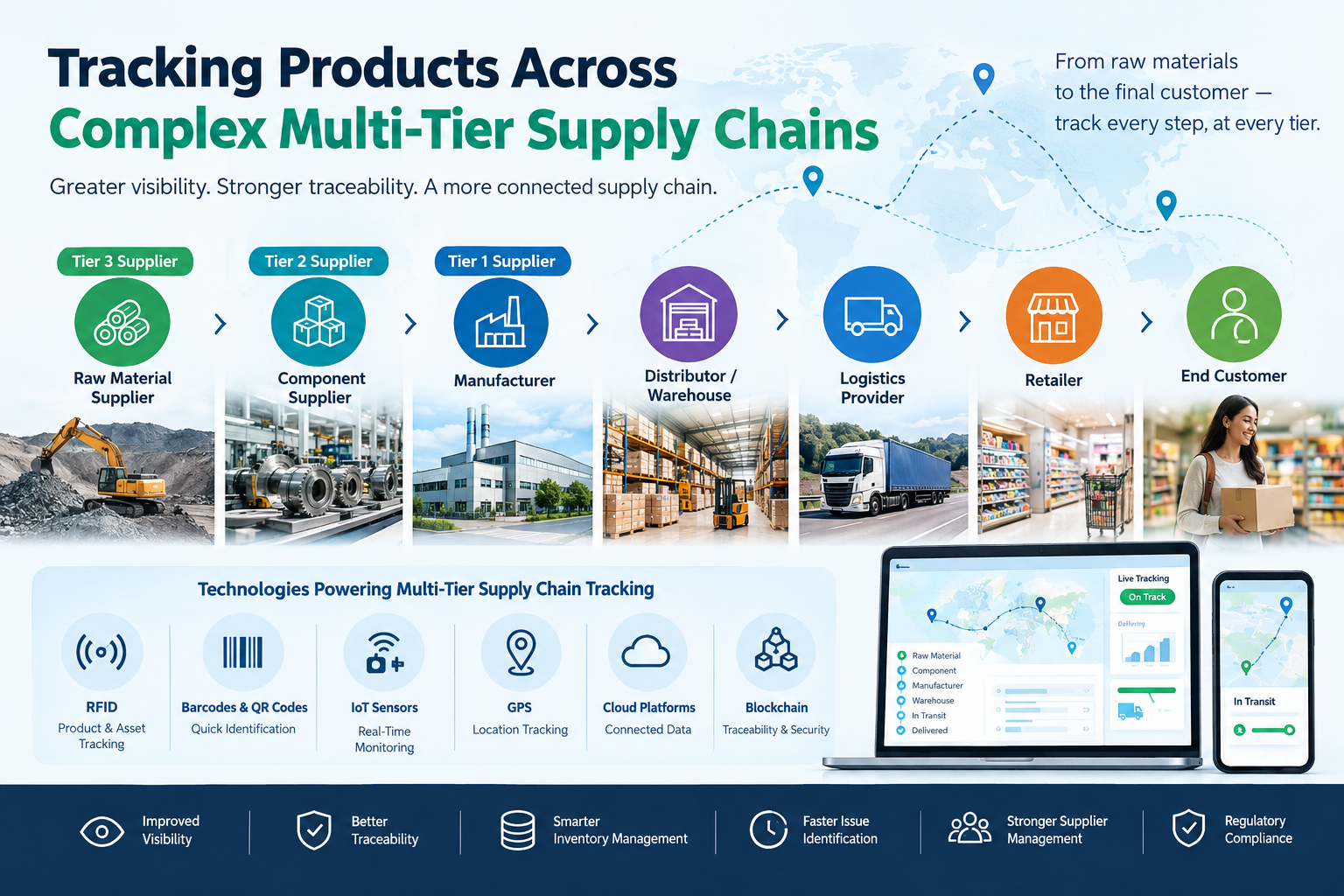
  • Tracking Products Across Complex Multi-Tier Supply Chains

    Tracking Products Across Complex Multi-Tier Supply Chains

    Tracking Products Across Complex Multi-Tier Supply Chains

    Modern supply chains are becoming more complex as businesses work with multiple suppliers, manufacturers, distributors, logistics providers, and other partners across different locations. A single product may pass through several supply chain stages before reaching the final customer.

    This complexity makes it difficult for businesses to know where products are, who handled them, and whether they moved through the supply chain as expected. Multi-tier supply chain tracking helps businesses improve visibility by connecting product information across different levels of the supply network.

    With technologies such as RFID, barcodes, IoT sensors, GPS, cloud platforms, and digital traceability systems, companies can monitor products more effectively and build a more transparent supply chain.

    What Is Multi-Tier Supply Chain Tracking?

    Multi-tier supply chain tracking is the process of monitoring products, materials, components, and shipments across multiple levels of a supply chain.

    A multi-tier supply chain can include:

    • Raw material suppliers
    • Tier 1 suppliers
    • Tier 2 suppliers
    • Tier 3 suppliers
    • Manufacturers
    • Warehouses
    • Distributors
    • Logistics providers
    • Retailers
    • Final customers

    Instead of tracking products only between a business and its direct suppliers, multi-tier tracking provides visibility across multiple supplier and distribution levels.

    Understanding Tier 1, Tier 2, and Tier 3 Suppliers

    Tier 1 suppliers usually work directly with the manufacturer or primary business.

    Tier 2 suppliers provide materials or components to Tier 1 suppliers, while Tier 3 suppliers may provide the raw materials used further upstream.

    For example, an automotive manufacturer may purchase components from a Tier 1 supplier. That supplier may source smaller components from Tier 2 suppliers, while Tier 2 suppliers may depend on raw material providers at Tier 3.

    Without proper tracking, businesses may have limited visibility into these upstream relationships.

    How Products Move Across Multiple Supply Chain Tiers

    Products and materials can move through many stages before reaching their destination. At each stage, information such as product identification, location, quantity, shipment status, and handling history may need to be recorded.

    A connected tracking system allows this information to be collected and shared across the supply chain.

    Why Traditional Tracking Methods Are Not Enough

    Traditional tracking methods often depend on spreadsheets, emails, manual records, and disconnected systems. These approaches can make it difficult to obtain real-time information.

    When data is fragmented, businesses may struggle to identify delays, inventory discrepancies, damaged products, or the source of a supply chain problem.

    Why Tracking Products Across Multi-Tier Supply Chains Is Challenging

    Tracking products across a complex supply chain presents several challenges.

    Limited Visibility Beyond Tier 1 Suppliers

    Businesses often have detailed information about their direct suppliers but limited information about suppliers further upstream.

    This creates visibility gaps that can make it difficult to understand where materials originated or how they moved through the supply network.

    Fragmented Supply Chain Data

    Different suppliers and logistics partners may use different systems, databases, product identifiers, and reporting processes.

    Combining this information into one reliable view can therefore be challenging.

    Manual Tracking and Data Errors

    Manual data entry can result in incorrect quantities, duplicate records, missing information, and delayed updates.

    These errors can affect inventory planning and product traceability.

    Delays in Sharing Product Information

    When supply chain partners do not share information in real time, businesses may discover problems only after they have affected production, inventory, or delivery schedules.

    Compliance and Traceability Challenges

    Many industries require businesses to maintain records about products, materials, suppliers, and movement through the supply chain.

    Without reliable tracking, maintaining accurate traceability records can become difficult.

    How Multi-Tier Supply Chain Tracking Works

    A multi-tier tracking system connects product information from different supply chain stages and creates a more complete view of product movement.

    Product Identification and Digital Records

    Products and materials can be assigned unique identifiers using technologies such as barcodes, QR codes, RFID tags, or other digital identification methods.

    These identifiers allow businesses to associate products with relevant information throughout their lifecycle.

    Data Collection at Each Supply Chain Stage

    Information can be collected whenever a product enters or leaves a facility, changes ownership, reaches a warehouse, or moves between locations.

    The collected information can include:

    • Product ID
    • Supplier information
    • Quantity
    • Location
    • Shipment status
    • Date and time
    • Batch or lot information
    • Handling history

    Real-Time Tracking and Monitoring

    IoT devices, GPS technologies, RFID systems, and connected sensors can help businesses monitor products and shipments.

    Depending on the use case, companies can track location, temperature, humidity, movement, and other conditions.

    Connecting Suppliers, Manufacturers, and Distributors

    Cloud-based platforms can connect information from different supply chain participants.

    This makes it easier for authorized users to access relevant information and identify potential issues across multiple supply chain tiers.

    Technologies Used for Multi-Tier Supply Chain Tracking

    Several technologies can support multi-tier supply chain tracking.

    RFID for Product and Asset Tracking

    RFID uses radio-frequency technology to identify and track tagged products or assets.

    Unlike traditional barcode scanning, RFID can allow multiple tagged items to be identified without requiring direct line-of-sight in many operational environments.

    Barcodes and QR Codes

    Barcodes and QR codes are widely used for product identification and tracking.

    They can provide a cost-effective way to associate products with digital information and tracking records.

    IoT Sensors and Real-Time Monitoring

    IoT sensors can collect information from products, vehicles, warehouses, and other supply chain assets.

    For temperature-sensitive products, for example, sensors can monitor environmental conditions during transportation and storage.

    GPS and Location Tracking

    GPS can help businesses monitor the location of vehicles, shipments, and high-value assets.

    Location data can provide greater visibility into transportation activities and delivery progress.

    Cloud-Based Supply Chain Platforms

    Cloud platforms can bring information from different supply chain systems into a centralized environment.

    This can help businesses monitor inventory, shipments, suppliers, and product movements from a single interface.

    Blockchain for Supply Chain Traceability

    Blockchain can provide a shared digital record of transactions and product events.

    It may be useful in situations where multiple organizations need a tamper-resistant record of supply chain activities, although implementation requirements and business needs should be evaluated carefully.

    Benefits of Multi-Tier Supply Chain Tracking

    Effective multi-tier supply chain tracking can provide several operational benefits.

    Improved Supply Chain Visibility

    Businesses can gain a clearer understanding of where products and materials are located across different supply chain stages.

    Faster Identification of Product Issues

    When products can be traced through different supply chain stages, businesses can more quickly identify where a problem occurred.

    Better Inventory Management

    Accurate tracking data can help businesses understand inventory levels and product movement, supporting better planning and replenishment.

    Reduced Product Loss and Delays

    Real-time information can help businesses identify shipment delays, misplaced products, and other issues earlier.

    Improved Supplier Management

    Tracking information can help businesses understand supplier activity and identify supply chain dependencies.

    Better Regulatory Compliance

    Accurate product records can make it easier to maintain documentation and trace products when industry regulations require detailed supply chain information.

    How to Implement Multi-Tier Supply Chain Tracking

    Businesses should approach implementation systematically rather than introducing technology without first understanding their supply chain.

    Map All Supply Chain Tiers

    Start by identifying suppliers, manufacturers, warehouses, distributors, logistics providers, and other relevant participants.

    Understanding the complete supply network helps identify visibility gaps.

    Define Tracking Requirements

    Determine what needs to be tracked.

    For example, a business may need to track:

    • Product location
    • Inventory
    • Batch numbers
    • Supplier information
    • Shipment status
    • Temperature
    • Product movement
    • Delivery events

    Select the Right Tracking Technology

    The appropriate technology depends on the product, industry, operating environment, budget, and tracking requirements.

    RFID may work well for automated identification, while GPS may be more appropriate for vehicle tracking and IoT sensors may be useful for monitoring environmental conditions.

    Integrate Data Across Supply Chain Partners

    Connecting supplier, warehouse, manufacturing, and logistics data can create a more complete view of the supply chain.

    APIs, cloud platforms, and system integrations can help exchange relevant information between different systems.

    Monitor and Analyze Supply Chain Data

    Once tracking is operational, businesses should continuously monitor the data.

    Analytics dashboards can help identify delays, inventory issues, supplier dependencies, and other patterns that require attention.

    Use Cases of Multi-Tier Supply Chain Tracking

    Multi-tier tracking can be applied across several industries.

    Pharmaceutical and Healthcare Supply Chains

    Pharmaceutical products may require detailed tracking from manufacturing through distribution.

    Traceability systems can help businesses monitor batches, shipments, storage conditions, and product movement.

    Food and Beverage Traceability

    Food businesses can track ingredients, batches, processing stages, storage, and distribution.

    This can support faster identification of products affected by quality or safety issues.

    Automotive Supply Chains

    Automotive products contain components sourced from numerous suppliers.

    Multi-tier tracking can help manufacturers understand the movement and origin of components across complex supplier networks.

    Retail and Consumer Goods

    Retailers can track products from suppliers through warehouses and distribution centers to stores and customers.

    This can improve inventory visibility and product availability.

    Manufacturing and Industrial Supply Chains

    Manufacturers can track raw materials, components, work-in-progress products, finished goods, and industrial assets across different locations.

    Best Practices for Tracking Products Across Multi-Tier Supply Chains

    Businesses can improve the effectiveness of their tracking systems by following several practices.

    Standardize Product Identification

    Use consistent product identification methods across relevant supply chain stages.

    Standardized identifiers make it easier to connect product information from different systems.

    Maintain Accurate and Centralized Data

    Tracking systems are only useful when the underlying data is reliable.

    Businesses should establish processes for maintaining accurate product, supplier, inventory, and shipment information.

    Establish Supplier Data-Sharing Processes

    Suppliers should understand what information needs to be collected and shared.

    Clear data-sharing requirements can reduce information gaps between supply chain partners.

    Use Real-Time Monitoring Where Needed

    Not every product requires continuous real-time monitoring.

    Businesses should identify critical products, shipments, and processes where real-time visibility provides meaningful operational value.

    Regularly Audit Supply Chain Data

    Regular data audits can help identify missing records, incorrect information, and gaps in supplier reporting.

    Future of Multi-Tier Supply Chain Tracking

    Supply chain tracking is becoming increasingly connected and data-driven.

    AI-Powered Supply Chain Visibility

    AI can analyze large amounts of supply chain data to identify patterns, anomalies, and potential disruptions.

    Predictive Analytics

    Predictive analytics can help businesses analyze historical and real-time data to anticipate potential delays, demand changes, or inventory problems.

    IoT-Enabled Traceability

    IoT devices can continuously collect information from products, vehicles, warehouses, and production environments.

    Digital Supply Chain Twins

    Digital twins can create virtual representations of supply chain operations, helping businesses analyze processes and evaluate potential scenarios.

    Conclusion

    Tracking products across complex multi-tier supply chains is becoming increasingly important as businesses depend on larger and more interconnected supplier networks.

    Multi-tier supply chain tracking provides businesses with greater visibility into product movement, supplier relationships, inventory, shipments, and traceability records.

    By combining technologies such as RFID, barcodes, IoT, GPS, cloud platforms, and analytics, businesses can create more connected and transparent supply chains.

    The right approach depends on the organization’s products, suppliers, industry requirements, and operational goals. Businesses that establish clear tracking processes and connect data across supply chain partners can build stronger visibility and improve their ability to manage complex supply networks.

    Frequently Asked Questions

    Q1. What is multi-tier supply chain tracking?

    Multi-tier supply chain tracking is the process of monitoring products, materials, and components across multiple levels of a supply chain, including Tier 1, Tier 2, and Tier 3 suppliers.

    Q2. Why is tracking across multiple supply chain tiers important?

    It helps businesses improve visibility beyond their direct suppliers and understand how products and materials move through different stages of the supply network.

    Q3. What technologies are used for multi-tier supply chain tracking?

    Common technologies include RFID, barcodes, QR codes, GPS, IoT sensors, cloud platforms, analytics, and blockchain-based traceability systems.

    Q4. How does RFID improve supply chain tracking?

    RFID can automatically identify tagged products and assets, helping businesses capture product movement information with less manual scanning.

    Q5. How can businesses improve visibility across Tier 2 and Tier 3 suppliers?

    Businesses can improve visibility by mapping their supplier network, establishing data-sharing requirements, standardizing product identification, integrating supply chain systems, and using digital tracking technologies.

  • How Traceability Helps Identify Supply Chain Bottlenecks

    How Traceability Helps Identify Supply Chain Bottlenecks

    How Traceability Helps Identify Supply Chain Bottlenecks

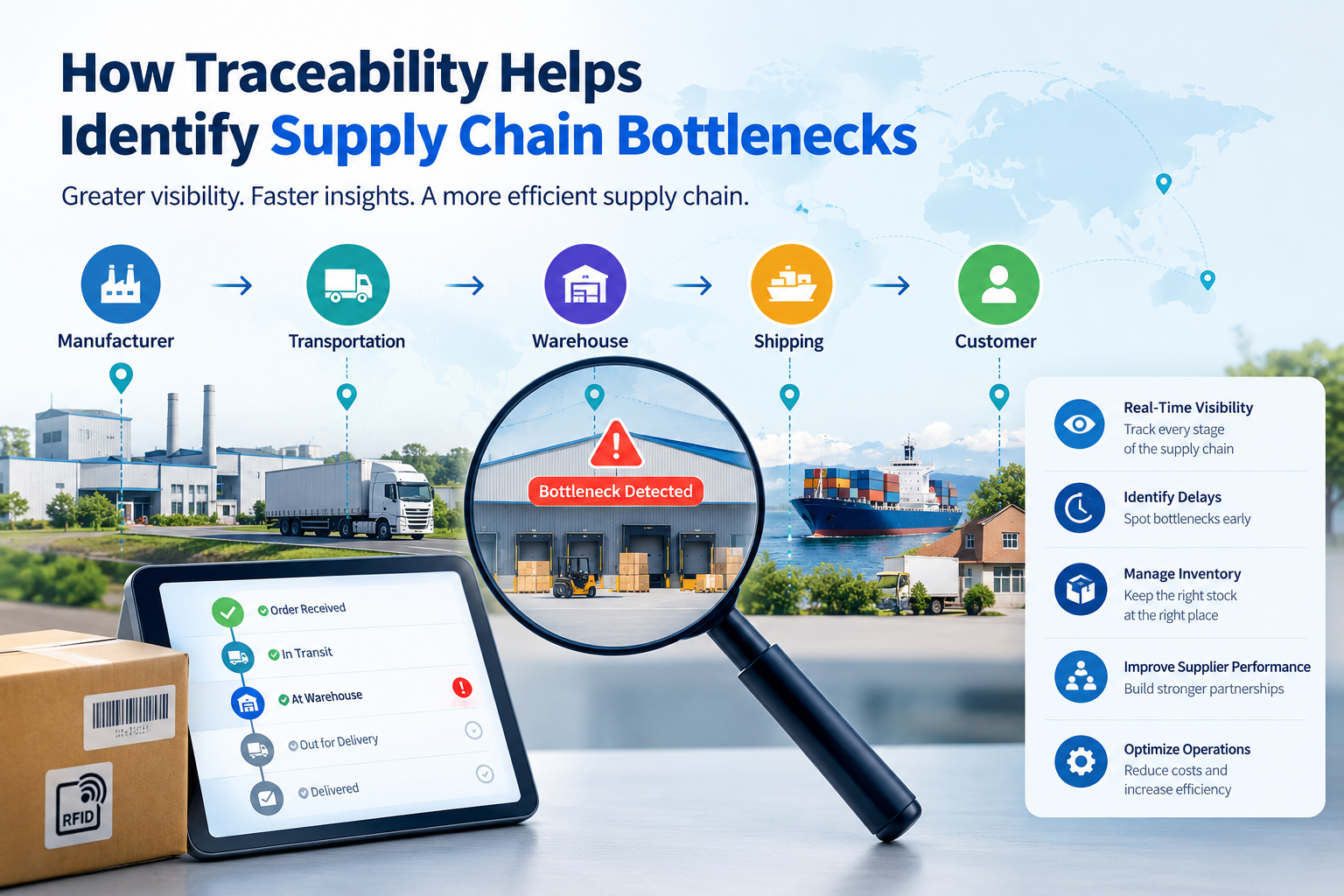
    Supply chains involve many connected processes, including sourcing, manufacturing, warehousing, transportation, and delivery. When one part of the process slows down, it can affect the entire supply chain. These delays are commonly known as supply chain bottlenecks.

    Businesses need clear visibility into their operations to identify where delays are happening and why they occur. This is where supply chain traceability becomes important. Traceability allows businesses to track products, materials, inventory, and processes as they move through different stages of the supply chain.

    By collecting and analyzing supply chain data, companies can identify delays, locate inefficient processes, monitor supplier performance, and take corrective action before small problems become major disruptions.

    What Is Supply Chain Traceability?

    Supply chain traceability is the ability to track the movement and history of products, materials, and information throughout the supply chain.

    It provides businesses with information about where a product came from, where it is currently located, what processes it has passed through, and where it is going next.

    How Supply Chain Traceability Works

    A traceability system collects data at different points in the supply chain. For example, a product can be tracked when it enters a warehouse, moves to production, leaves the facility, and reaches a distribution center.

    Technologies such as RFID, barcodes, QR codes, IoT sensors, GPS, and cloud-based platforms can help collect and share this information.

    Key Data Captured Through Traceability

    A supply chain traceability system may capture information such as:

    • Product identification
    • Inventory levels
    • Supplier information
    • Shipment status
    • Warehouse movements
    • Production stages
    • Delivery information
    • Time and location data
    • Product batches and lots

    This information helps businesses understand what is happening across their supply chain.

    What Are Supply Chain Bottlenecks?

    A supply chain bottleneck occurs when a particular process, location, supplier, or resource cannot handle the required workload efficiently.

    For example, if a warehouse takes too long to process incoming shipments, products may remain stuck at that stage. This can delay transportation, distribution, and final delivery.

    Common Causes of Supply Chain Bottlenecks

    Some common causes include:

    • Poor inventory management
    • Supplier delays
    • Warehouse processing issues
    • Transportation delays
    • Manual data entry
    • Limited production capacity
    • Equipment failures
    • Poor communication between supply chain partners
    • Lack of real-time visibility

    How Bottlenecks Affect Supply Chain Performance

    Even a small bottleneck can create a chain reaction. Delays at one stage can increase inventory holding costs, affect production schedules, delay customer orders, and reduce overall operational efficiency.

    Identifying bottlenecks early allows businesses to address problems before they become larger disruptions.

    How Traceability Helps Identify Supply Chain Bottlenecks

    Supply chain traceability provides businesses with visibility into different stages of their operations. Instead of relying only on manual records or delayed reports, companies can use real-time or near-real-time data to identify where products and materials are located.

    Real-Time Visibility Across the Supply Chain

    Traceability systems can provide visibility into the movement of products and materials.

    For example, if a shipment remains at a particular warehouse longer than expected, the business can investigate the reason for the delay. This helps teams identify potential bottlenecks more quickly.

    Identifying Delays and Process Inefficiencies

    Traceability data can show how long products spend at different stages.

    If products consistently take longer than expected during picking, packing, production, or transportation, businesses can investigate that specific process.

    This makes it easier to determine whether the problem is related to people, equipment, inventory, transportation, or workflow.

    Tracking Inventory Movement

    Inventory that cannot be located quickly can create operational delays.

    Traceability systems help businesses monitor inventory movement from receiving to storage, production, picking, packing, and dispatch. This can reduce the time employees spend searching for products and materials.

    Finding Supplier and Logistics Issues

    Supplier performance can have a significant impact on the supply chain.

    By tracking purchase orders, shipments, delivery times, and product movements, businesses can identify suppliers or logistics processes that frequently cause delays.

    This information can help supply chain managers investigate recurring issues and improve coordination.

    Detecting Recurring Bottlenecks

    Some bottlenecks happen repeatedly rather than as one-time events.

    By analyzing historical traceability data, companies can identify patterns. For example, a particular warehouse location may regularly experience delays, or shipments from a specific supplier may frequently arrive late.

    Identifying these patterns allows businesses to focus on the root cause instead of repeatedly fixing the same problem.

    Key Benefits of Using Traceability to Reduce Bottlenecks

    Supply chain traceability can provide several operational benefits when implemented correctly.

    Improved Supply Chain Visibility

    Businesses gain better visibility into products, materials, shipments, and processes. This makes it easier to understand where goods are and what is happening at each stage.

    Faster Problem Identification

    When supply chain data is available quickly, teams can identify unusual delays and investigate them sooner.

    Better Inventory Management

    Accurate tracking helps businesses understand inventory availability and movement. This can reduce unnecessary searching, stock discrepancies, and delays caused by missing materials.

    Improved Supplier Performance

    Traceability data can help companies monitor supplier delivery times, order accuracy, and shipment performance.

    Reduced Operational Costs

    Finding bottlenecks can help businesses reduce unnecessary delays, excessive inventory holding, manual work, and transportation inefficiencies.

    Technologies That Support Supply Chain Traceability

    Modern traceability systems can combine multiple technologies to create better visibility.

    RFID Technology

    RFID uses radio-frequency identification tags and readers to automatically identify and track products, assets, and inventory.

    It can be particularly useful in warehouses, manufacturing facilities, retail operations, and logistics.

    Barcode and QR Code Tracking

    Barcodes and QR codes provide a simple way to identify and track products, packages, batches, and shipments.

    When integrated with supply chain software, scanning data can provide information about product movement and status.

    IoT and Real-Time Tracking

    IoT devices and sensors can collect information about location, temperature, humidity, movement, and other conditions.

    This can be useful for industries where product conditions need to be monitored throughout transportation and storage.

    AI and Data Analytics

    AI and analytics can help businesses analyze large volumes of supply chain data.

    These technologies can identify patterns, detect unusual activity, and support predictive analysis that helps businesses respond to potential supply chain problems.

    How to Implement Supply Chain Traceability

    Implementing traceability requires more than simply installing tracking technology. Businesses should first understand their processes and determine where visibility is most important.

    Map Your Supply Chain Processes

    Start by documenting the major stages of the supply chain, from suppliers and manufacturing to warehousing, transportation, and delivery.

    This helps identify where tracking information is currently available and where visibility is missing.

    Identify Critical Tracking Points

    Not every stage requires the same level of tracking.

    Businesses should identify important points where delays, losses, quality issues, or inventory problems are most likely to occur.

    Choose the Right Traceability Technology

    The appropriate technology depends on the business requirements.

    For example, RFID may be useful for automated inventory tracking, while barcodes may be suitable for cost-effective product identification. IoT sensors may be useful when environmental conditions need to be monitored.

    Monitor and Analyze Supply Chain Data

    Collecting data is only the first step. Businesses need to regularly analyze the information to identify delays, unusual patterns, and recurring bottlenecks.

    Dashboards and automated alerts can help supply chain teams respond more quickly.

    Real-World Example of Bottleneck Identification Through Traceability

    Consider a company that operates several warehouses.

    The company notices that some customer orders are consistently delivered late. Without detailed tracking data, it may be difficult to determine whether the problem is related to inventory, warehouse processing, or transportation.

    With a traceability system, the company can review the movement history of affected orders.

    Example: Identifying a Warehouse Processing Delay

    The data may show that products are arriving at the warehouse on time but spending several hours waiting for picking and packing.

    This indicates that the warehouse processing stage may be creating the bottleneck.

    The company can then investigate staffing, warehouse layout, equipment, or workflow issues and take appropriate action.

    Example: Detecting a Supplier Delivery Issue

    A business may also discover that a specific supplier frequently delivers materials later than the agreed schedule.

    By comparing supplier delivery data over time, the company can identify the recurring issue and work with the supplier to improve delivery performance.

    Best Practices for Reducing Supply Chain Bottlenecks

    Businesses can improve the value of traceability by following several best practices.

    Maintain Accurate and Real-Time Data

    Incorrect or outdated information can lead to poor decisions. Businesses should ensure that tracking data is accurate and updated as products move through the supply chain.

    Connect Suppliers, Warehouses, and Logistics

    Supply chain visibility becomes more useful when information can be shared across different supply chain partners.

    Connecting systems can reduce information gaps and improve coordination.

    Use Automated Alerts

    Automated alerts can notify teams when a shipment is delayed, inventory falls below a threshold, or a process takes longer than expected.

    This allows teams to investigate problems before they become major disruptions.

    Continuously Monitor Performance

    Supply chains change over time. Businesses should regularly review traceability data and performance indicators to identify new bottlenecks and improve processes.

    Conclusion

    Supply chain traceability provides businesses with greater visibility into the movement of products, materials, and information. By tracking activities across suppliers, warehouses, manufacturing facilities, transportation networks, and distribution centers, companies can better understand where delays occur.

    Traceability does not simply show where a product is. When combined with analytics and appropriate tracking technologies, it can help businesses identify recurring delays, investigate process inefficiencies, monitor supplier performance, and improve supply chain operations.

    For businesses looking to improve supply chain visibility, traceability can be an important part of building a more connected and data-driven supply chain.

    Frequently Asked Questions About Supply Chain Traceability

    Q1. How does traceability help identify supply chain bottlenecks?

    Traceability provides information about product movement and process times. Businesses can use this data to identify where products are experiencing delays and investigate the causes.

    Q2. What technologies are used for supply chain traceability?

    Common technologies include RFID, barcodes, QR codes, IoT sensors, GPS tracking, cloud platforms, and data analytics.

    Q3. Can traceability reduce supply chain delays?

    Traceability can help businesses identify the sources of delays more quickly. Once the bottleneck is identified, companies can investigate and improve the affected process.

    Q4. How does RFID improve supply chain visibility?

    RFID can automatically identify and track tagged products and assets. This can provide businesses with more efficient inventory and movement tracking.

    Q5. Why is real-time supply chain data important?

    Real-time or near-real-time data helps businesses understand what is happening across their supply chain and respond more quickly when delays or other issues occur.

  • Improving Supplier-to-Customer Visibility With Digital Traceability

    Improving Supplier-to-Customer Visibility With Digital Traceability

    Improving Supplier-to-Customer Visibility With Digital Traceability

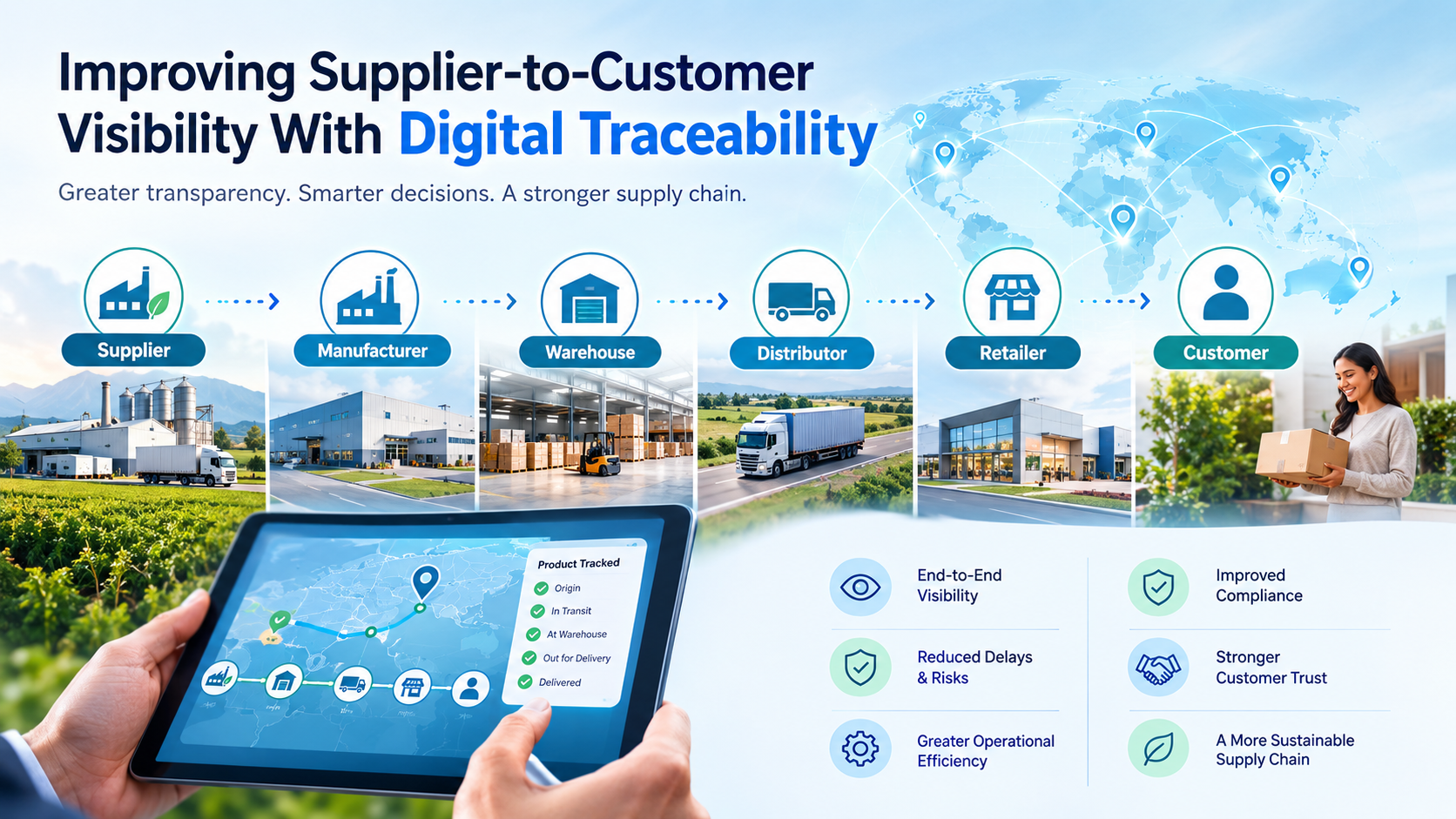
    Modern supply chains involve multiple suppliers, manufacturers, warehouses, distributors, retailers, and customers. With so many parties involved, it can become difficult for businesses to know where products are, what is happening to them, and whether they are moving according to plan.

    Digital traceability helps solve this problem by providing businesses with better visibility into products, materials, shipments, and processes throughout the supply chain. By collecting and connecting data at different stages, companies can improve transparency, identify problems faster, and provide customers with more reliable information.

    What Is Digital Traceability in the Supply Chain?

    Digital traceability is the process of using digital technologies to track and record the movement of products, materials, and information throughout the supply chain.

    Instead of depending on manual records or disconnected systems, businesses can use technologies such as RFID, barcodes, IoT sensors, cloud platforms, and data analytics to create a connected view of their supply chain.

    How Digital Traceability Works

    Digital traceability begins when a product or raw material enters the supply chain. A unique identifier, such as a barcode, QR code, or RFID tag, can be assigned to the item.

    As the product moves between suppliers, manufacturers, warehouses, distributors, and retailers, important information can be recorded at different points.

    This information may include:

    • Product identification
    • Supplier information
    • Manufacturing details
    • Location
    • Shipment status
    • Inventory information
    • Temperature or environmental conditions
    • Delivery information

    The collected information can then be stored and analyzed through digital platforms, giving businesses greater visibility into their supply chain.

    Why Supply Chain Traceability Matters

    Without proper traceability, businesses may struggle to identify where a product came from, where it is currently located, or what happened during transportation.

    Digital traceability creates a record of important supply chain activities. This can help businesses investigate problems, improve operations, support compliance, and provide customers with more accurate product information.

    Why Supplier-to-Customer Visibility Is Important

    Supplier-to-customer visibility means having a clear understanding of what happens to products and materials from the supplier stage through the final customer.

    When information is available across the supply chain, businesses can make decisions based on current and reliable data.

    Improving Supply Chain Transparency

    A connected supply chain allows businesses to see information from different stages in one place.

    For example, a manufacturer can monitor incoming materials from suppliers, production progress, warehouse inventory, and outgoing shipments. This creates greater transparency between different supply chain participants.

    Reducing Delays and Operational Risks

    Supply chain delays can happen because of transportation problems, inventory shortages, production issues, or communication gaps.

    Digital traceability can help businesses identify where a delay has occurred and provide information that supports faster investigation and response.

    Building Customer Trust

    Customers increasingly want to know where products come from and how they reach them.

    Providing accurate product and shipment information can improve transparency and help businesses build stronger relationships with customers.

    How Digital Traceability Improves Supplier-to-Customer Visibility

    Digital traceability connects information from different points in the supply chain and makes that information easier to access and analyze.

    Tracking Products Across the Supply Chain

    Businesses can use barcodes, QR codes, RFID tags, and IoT devices to track products as they move through different stages.

    This allows organizations to understand product movement from the supplier to manufacturing, warehousing, distribution, and delivery.

    Connecting Suppliers, Manufacturers, and Distributors

    Supply chain visibility becomes difficult when each business partner uses separate systems.

    Digital platforms can help connect information from suppliers, manufacturers, logistics providers, distributors, and other stakeholders. This reduces information gaps and makes collaboration easier.

    Providing Real-Time Supply Chain Data

    Traditional supply chain records may depend on manual updates, which can result in outdated information.

    Connected technologies can automatically capture and update information as products move through the supply chain. This gives businesses a more current view of inventory, shipments, and product status.

    Improving Product and Shipment Traceability

    Digital traceability creates a digital record of important product and shipment activities.

    If an issue occurs, businesses can use this information to identify affected products, locations, suppliers, or shipments more efficiently.

    Key Technologies Used for Digital Traceability

    Several technologies can work together to create an effective digital traceability system.

    RFID and Barcode Tracking

    RFID tags and barcodes are commonly used to identify and track products, packages, assets, and inventory.

    Barcodes generally require scanning, while RFID technology can allow identification without direct line-of-sight in suitable environments.

    IoT Sensors and Connected Devices

    IoT devices can collect information about products, vehicles, warehouses, and environmental conditions.

    For example, sensors can monitor temperature, humidity, location, or movement during transportation. This information can be useful when products require specific storage or transportation conditions.

    Cloud-Based Supply Chain Platforms

    Cloud platforms can bring supply chain information together in a centralized environment.

    Authorized users can access relevant information from different locations, helping suppliers, manufacturers, logistics providers, and businesses collaborate more effectively.

    Data Analytics and Artificial Intelligence

    Supply chain data can be analyzed to identify patterns, inefficiencies, and potential problems.

    AI and analytics can help businesses understand historical data, detect unusual activity, forecast demand, and support supply chain decision-making.

    Blockchain for Supply Chain Transparency

    Blockchain can provide a distributed record of selected supply chain transactions.

    When appropriately implemented, it can help different stakeholders share and verify certain records while maintaining a history of transactions.

    Benefits of Digital Traceability for Businesses

    Implementing digital traceability can provide benefits across different areas of supply chain operations.

    Better Inventory Visibility

    Businesses can gain a clearer understanding of inventory levels and product locations.

    Better visibility can help organizations identify stock discrepancies, improve inventory planning, and reduce unnecessary delays.

    Faster Identification of Supply Chain Issues

    When information is collected across multiple supply chain stages, businesses can investigate problems more efficiently.

    For example, if a shipment is delayed, tracking information can help identify its last known location and relevant events.

    Improved Regulatory Compliance

    Many industries require businesses to maintain records related to products, materials, manufacturing, transportation, and distribution.

    Digital traceability can help organizations maintain organized records and retrieve relevant information when required.

    Reduced Product Loss and Errors

    Automated identification and tracking can reduce dependence on manual data entry.

    More accurate product information can help reduce issues such as misplaced inventory, incorrect shipments, and tracking errors.

    Better Customer Experience

    Customers can benefit from accurate delivery information, product details, and greater transparency.

    Businesses can also respond to customer questions more quickly when relevant supply chain information is readily available.

    How to Implement Digital Traceability

    A successful digital traceability strategy requires more than simply adding a tracking technology. Businesses need to consider their processes, systems, data, and supply chain partners.

    Identify Supply Chain Visibility Gaps

    Start by identifying where information is currently missing or difficult to access.

    Businesses should examine supplier management, production, warehousing, transportation, distribution, and customer delivery processes.

    Select the Right Tracking Technologies

    The appropriate technology depends on the type of products, operating environment, budget, and tracking requirements.

    Businesses may use barcodes, RFID, QR codes, IoT sensors, GPS, cloud platforms, or a combination of technologies.

    Integrate Supplier and Customer Data

    Traceability becomes more useful when information from different systems can work together.

    Integration can connect supplier information with manufacturing, warehouse, logistics, and customer-facing systems.

    Monitor and Analyze Supply Chain Data

    Collecting data is only the first step. Businesses should regularly analyze the information to identify delays, inventory issues, process inefficiencies, and other supply chain problems.

    Continuously Improve Traceability Processes

    Supply chains change over time. Businesses should regularly review their traceability systems and update processes as new technologies, suppliers, products, and customer requirements emerge.

    Challenges of Implementing Digital Traceability

    Although digital traceability offers significant operational benefits, implementation can involve several challenges.

    Data Integration Challenges

    Different suppliers and business partners may use different software platforms and data formats.

    Connecting these systems can require integration work and standardized data processes.

    Technology and Implementation Costs

    Businesses may need to invest in hardware, software, sensors, integration, training, and maintenance.

    The implementation strategy should therefore be aligned with the organization’s operational requirements and available resources.

    Supplier Adoption and Collaboration

    A supply chain involves multiple organizations. If suppliers or logistics partners do not share the required information, complete visibility can be difficult to achieve.

    Clear processes and communication between stakeholders are important for successful implementation.

    Data Security and Privacy

    Digital traceability systems handle large amounts of business and operational information.

    Organizations should use appropriate access controls, security practices, and data management policies to protect sensitive information.

    Future of Digital Traceability in Supply Chains

    Digital traceability is expected to become increasingly connected as businesses adopt technologies such as AI, IoT, cloud computing, and advanced analytics.

    AI-Powered Supply Chain Visibility

    AI can help organizations analyze large amounts of supply chain data and identify patterns that may be difficult to detect manually.

    Businesses can use these insights to support planning, risk management, and operational decision-making.

    Real-Time IoT Tracking

    IoT devices can provide continuous information about products, vehicles, assets, and environmental conditions.

    As connected devices become more widely adopted, businesses can develop more detailed views of supply chain activities.

    Predictive Supply Chain Analytics

    Instead of only understanding what has already happened, businesses can use historical and current data to identify potential future issues.

    Predictive analytics can support areas such as demand planning, inventory management, transportation, and maintenance.

    Increasing Demand for End-to-End Traceability

    Customers, regulators, and business partners are placing greater importance on transparency and product information.

    This is increasing the need for businesses to develop traceability systems that connect different stages of the supply chain.

    Conclusion

    Improving supplier-to-customer visibility requires businesses to connect information across the entire supply chain. Digital traceability provides a practical way to track products, capture important data, and improve transparency from suppliers to final customers.

    By combining technologies such as RFID, barcodes, IoT, cloud platforms, and analytics, businesses can develop a more connected view of their operations. This can support better inventory management, faster issue identification, improved transparency, and a better customer experience.

    As supply chains become more complex, digital traceability can play an important role in helping businesses create more connected, transparent, and data-driven supply chain operations.

    Frequently Asked Questions About Digital Traceability

    Q1. What is digital traceability?

    Digital traceability is the use of digital technologies to track and record products, materials, and processes as they move through different stages of the supply chain.

    Q2. How does digital traceability improve supply chain visibility?

    It connects information from suppliers, manufacturers, warehouses, logistics providers, distributors, and other supply chain stages, giving businesses a more complete view of product movement and status.

    Q3. What technologies are used for supply chain traceability?

    Common technologies include RFID, barcodes, QR codes, IoT sensors, GPS, cloud platforms, data analytics, and artificial intelligence.

    Q4. What are the benefits of digital traceability?

    Digital traceability can improve supply chain transparency, inventory visibility, product tracking, issue identification, compliance management, and customer communication.

    Q5. How can businesses implement digital traceability?

    Businesses can begin by identifying visibility gaps, selecting appropriate tracking technologies, integrating supply chain systems, establishing data standards, and continuously monitoring performance.

  • How Supply Chain Traceability Works Across Multiple Suppliers

    How Supply Chain Traceability Works Across Multiple Suppliers

    How Supply Chain Traceability Works Across Multiple Suppliers

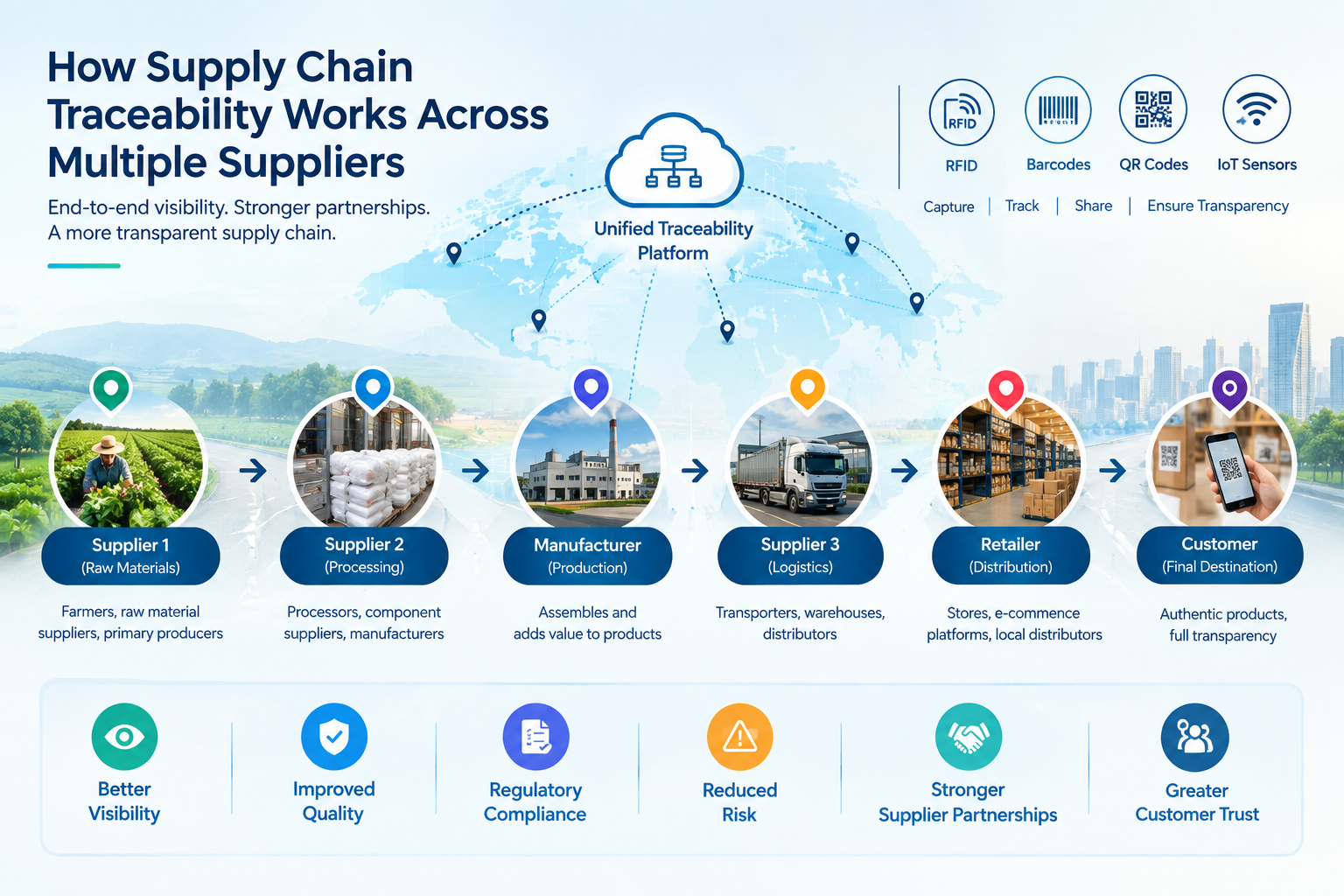
    Modern supply chains rarely depend on a single supplier. Manufacturers, distributors, retailers, and logistics providers often work with multiple vendors across different regions. While this improves flexibility and sourcing options, it also creates challenges in tracking products, materials, and information. This is where supply chain traceability becomes essential.

    Supply chain traceability allows businesses to monitor the movement of products, raw materials, and components from the source to the final customer. It provides complete visibility across all suppliers, helping organizations improve quality, ensure compliance, reduce risks, and build customer trust.

    What Is Supply Chain Traceability?

    Supply chain traceability is the process of recording, tracking, and monitoring products and materials throughout every stage of the supply chain. It enables businesses to identify where products come from, how they are processed, and where they are delivered.

    For companies working with multiple suppliers, traceability creates a connected view of supplier information, inventory, production, transportation, and delivery data.

    How Supply Chain Traceability Works Across Multiple Suppliers

    When several suppliers contribute materials or components, businesses need a structured system to collect and share information.

    Supplier Identification and Data Collection

    The first step is collecting data from every supplier. This includes:

    • Supplier details
    • Product information
    • Batch or lot numbers
    • Manufacturing dates
    • Shipping records
    • Compliance documents

    A centralized traceability platform stores this information and creates a digital record for every product.

    Tracking Materials From Source to Manufacturer

    Raw materials often pass through multiple suppliers before reaching manufacturers. Each movement is recorded using tracking technologies such as RFID tags, barcodes, QR codes, or IoT sensors.

    For example, a food manufacturer may source ingredients from different farms, processors, and packaging suppliers. Traceability systems connect data from every supplier to create an end-to-end product history.

    Connecting Data Across Multiple Supply Chain Partners

    A major challenge in multi-supplier environments is integrating data from different systems. Cloud-based traceability platforms help businesses combine information from suppliers, warehouses, transport providers, and production units into a single dashboard.

    This improves visibility and allows organizations to track products in real time.

    Using RFID, Barcodes, QR Codes, and IoT

    Several technologies support supply chain traceability:

    • RFID: Enables automatic product identification and tracking.
    • Barcodes: Provide cost-effective item tracking.
    • QR Codes: Offer detailed product information and easy scanning.
    • IoT Sensors: Monitor location, temperature, humidity, and movement.

    These technologies improve data accuracy and reduce manual errors.

    Real-Time Supply Chain Visibility

    Real-time visibility helps businesses identify delays, shortages, and quality issues quickly. Managers can monitor supplier performance, inventory levels, and shipment status through digital dashboards.

    This reduces disruptions and improves operational efficiency.

    Key Components of Multi-Supplier Supply Chain Traceability

    An effective traceability system includes several essential elements:

    Supplier Data Management

    Maintaining accurate supplier records is critical for traceability.

    Product and Batch Tracking

    Tracking batches allows businesses to identify affected products during recalls or quality issues.

    Digital Traceability Records

    Digital records improve transparency and simplify audits.

    Data Integration and Sharing

    Connected systems enable smooth communication between suppliers and business partners.

    Real-Time Monitoring and Alerts

    Automated alerts help businesses respond quickly to disruptions.

    Benefits of Supply Chain Traceability Across Multiple Suppliers

    Businesses gain several advantages from implementing traceability systems.

    Better Supply Chain Visibility

    Organizations can monitor products and materials at every stage.

    Faster Problem Identification

    Issues can be detected and resolved quickly.

    Improved Product Quality

    Better monitoring leads to consistent quality standards.

    Easier Regulatory Compliance

    Traceability supports compliance with industry regulations.

    Reduced Supply Chain Risk

    Companies can identify supplier risks and minimize disruptions.

    Improved Customer Trust

    Customers increasingly expect transparency regarding product origin and quality.

    Challenges of Tracking Multiple Suppliers

    Despite its benefits, multi-supplier traceability presents challenges.

    Inconsistent Supplier Data

    Different suppliers may use different formats and systems.

    Lack of Data Integration

    Disconnected systems can limit visibility.

    Limited Supply Chain Transparency

    Incomplete information can affect decision-making.

    Supplier Compliance Issues

    Not all suppliers maintain the same standards.

    Managing Large Volumes of Data

    Businesses need efficient systems to handle traceability information.

    Technologies Used for Multi-Supplier Traceability

    Several digital technologies strengthen traceability systems:

    RFID Technology

    Automates product identification and tracking.

    Barcode and QR Code Tracking

    Supports cost-effective inventory management.

    IoT Sensors

    Provide real-time monitoring.

    Cloud-Based Platforms

    Enable centralized data management.

    AI and Analytics

    Help predict risks and improve decision-making.

    Best Practices for Implementing Supply Chain Traceability

    To improve traceability across multiple suppliers, businesses should:

    • Standardize supplier data.
    • Integrate supply chain systems.
    • Automate data collection.
    • Monitor supplier performance.
    • Use real-time tracking technologies.
    • Maintain accurate digital records.

    Frequently Asked Questions

    Q1. What is supply chain traceability?

    Supply chain traceability is the ability to track products, materials, and information throughout the supply chain.

    Q2. How does traceability work across multiple suppliers?

    It combines supplier, inventory, production, and logistics data into a unified system.

    Q3. Which technologies support traceability?

    RFID, barcodes, QR codes, IoT sensors, cloud platforms, and AI are commonly used.

    Conclusion

    Supply chain traceability across multiple suppliers provides organizations with greater visibility, better quality control, and improved compliance. By connecting supplier data with technologies such as RFID, barcodes, IoT, and cloud platforms, businesses can build transparent and resilient supply chains. As global supply networks continue to grow, traceability will remain a key factor in improving efficiency, reducing risks, and strengthening customer trust.

  • B. Supply Chain Traceability

    B. Supply Chain Traceability

    Supply Chain Traceability: A Complete Guide to End-to-End Visibility

    Supply chains have become more complex as businesses source materials, manufacture products, and deliver goods across multiple locations. With so many stages involved, companies need to know where products come from, where they are currently located, and what happens to them throughout their journey.

    Supply chain traceability helps businesses track products, materials, and information from the point of origin to the final customer. By using technologies such as RFID, barcodes, IoT, cloud platforms, and data analytics, organizations can improve visibility, identify problems faster, and make better supply chain decisions.

    In this guide, we will explain what supply chain traceability is, how it works, its benefits, key technologies, challenges, and how businesses can implement a traceability system.

    What Is Supply Chain Traceability?

    Supply chain traceability is the ability to track and document the movement of products, materials, components, and related information throughout the supply chain.

    It creates a record of where a product comes from, what processes it goes through, where it moves, and where it ultimately reaches. This information can help businesses understand their supply chain and respond quickly when problems occur.

    For example, a manufacturer may use traceability to track raw materials from a supplier, monitor production, record warehouse movements, and track the finished product during distribution.

    How Supply Chain Traceability Works

    A typical traceability process includes:

    1. Identifying products or materials.
    2. Capturing information at different supply chain stages.
    3. Recording and storing the data.
    4. Tracking movement between locations.
    5. Monitoring products in real time where required.
    6. Using the collected information for analysis and decision-making.

    The exact process depends on the industry, product type, regulatory requirements, and technology used.

    Why Supply Chain Traceability Matters

    Without proper traceability, businesses may have difficulty identifying where a product came from or where a problem occurred.

    Traceability can help organizations:

    • Improve supply chain visibility
    • Track products and materials
    • Identify quality problems
    • Support product recalls
    • Improve inventory management
    • Meet regulatory requirements
    • Reduce operational risks
    • Provide customers with better product information

    How Does Supply Chain Traceability Work?

    Supply chain traceability connects information collected at different stages of the product lifecycle.

    Product Identification and Data Capture

    Products, packages, assets, and materials can be identified using barcodes, QR codes, RFID tags, serial numbers, or other identification methods.

    Information such as product ID, batch number, manufacturing date, location, and shipment details can then be captured and stored.

    Tracking Products Across the Supply Chain

    After identification, products can be tracked as they move between suppliers, factories, warehouses, distribution centers, retailers, and customers.

    This provides businesses with greater visibility into product movement and inventory status.

    Data Integration and Monitoring

    A traceability system can connect information from different business systems, including ERP, WMS, manufacturing, logistics, and inventory platforms.

    Integration helps create a more connected view of supply chain activities.

    Traceability Data Analysis

    Collected data can be analyzed to identify delays, inventory issues, quality problems, and other operational challenges.

    Businesses can use these insights to improve processes and make informed decisions.

    Key Components of Supply Chain Traceability

    An effective traceability system typically combines identification technologies, data collection, software, and analytics.

    RFID and Barcode Technology

    RFID tags and barcodes are widely used to identify and track products, packages, pallets, and assets.

    Barcodes generally require scanning, while RFID can allow compatible systems to identify tagged items without direct line-of-sight scanning.

    IoT and Real-Time Tracking

    IoT devices and sensors can collect information about location, temperature, humidity, movement, and other conditions.

    This can be particularly useful for products that require controlled transportation or storage.

    Cloud-Based Traceability Systems

    Cloud platforms can centralize supply chain information and make data accessible to authorized users across different locations.

    They can also support integration, reporting, and collaboration between supply chain partners.

    Data Integration and Analytics

    Integration connects traceability information with existing business systems.

    Analytics tools can then help organizations identify patterns, monitor performance, and investigate supply chain events.

    Benefits of Supply Chain Traceability

    Implementing supply chain traceability can provide operational and strategic benefits.

    Improved Supply Chain Visibility

    Traceability provides businesses with information about product movement and supply chain events.

    Better visibility can help teams understand what is happening across different stages of the supply chain.

    Better Product Quality and Safety

    Businesses can track batches, materials, and production information to help identify potential quality problems.

    If an issue is discovered, traceability data can help determine which products or batches may be affected.

    Faster Identification of Issues

    When supply chain problems occur, organizations can use traceability records to investigate where and when an issue happened.

    This can reduce the time required for root cause analysis.

    Improved Regulatory Compliance

    Many industries have specific requirements for product tracking, documentation, safety, and reporting.

    A structured traceability system can help businesses maintain the information required to support compliance processes.

    Reduced Operational Costs

    Better visibility can help organizations identify inefficiencies, reduce manual processes, improve inventory management, and minimize errors.

    The actual cost savings depend on the business process and implementation.

    Supply Chain Traceability Across Different Industries

    Traceability is used across industries where businesses need visibility into products, materials, and processes.

    Food and Agriculture

    Food businesses can use traceability to track ingredients, batches, processing activities, storage conditions, and distribution.

    This can support food safety investigations and product recalls.

    Pharmaceuticals and Healthcare

    Pharmaceutical supply chains require detailed information about products, batches, storage, and distribution.

    Traceability can help organizations monitor products throughout their supply chain.

    Manufacturing

    Manufacturers can track raw materials, components, production stages, finished goods, and shipments.

    This can support quality management and production visibility.

    Retail and E-commerce

    Retailers can use traceability to track products from suppliers through distribution centers and stores or directly to customers.

    It can also support inventory visibility and product authentication processes.

    Logistics and Transportation

    Logistics companies can use tracking technologies to monitor shipments, vehicles, containers, and other assets.

    This can provide greater visibility into transportation activities.

    Technologies Used in Supply Chain Traceability

    Modern traceability systems often combine several technologies rather than relying on a single solution.

    RFID

    Radio Frequency Identification uses tags and readers to identify and track objects.

    RFID can be useful for inventory, warehouse, asset, and logistics applications.

    Barcodes and QR Codes

    Barcodes and QR codes provide a practical way to identify products and connect them with digital information.

    They are widely used because they can be relatively simple to deploy and operate.

    Internet of Things (IoT)

    IoT sensors can collect information from physical objects and environments.

    Businesses can use this information for location monitoring, condition monitoring, and real-time visibility.

    Artificial Intelligence and Analytics

    AI and analytics can help businesses analyze large volumes of supply chain data.

    Potential applications include demand analysis, anomaly detection, risk monitoring, and predictive insights.

    Blockchain

    Blockchain can provide a distributed record of transactions between participating organizations.

    In some supply chain applications, it can support data sharing and record verification. However, blockchain is not required for every traceability implementation.

    Challenges of Supply Chain Traceability

    Although traceability provides significant visibility, implementation can also present challenges.

    Data Accuracy and Quality

    Traceability depends on accurate data. Incorrect, incomplete, or delayed information can reduce the usefulness of the system.

    Businesses need appropriate processes for data capture and validation.

    Integration With Existing Systems

    Companies may already use ERP, warehouse, manufacturing, logistics, or inventory systems.

    Connecting these systems with a traceability platform can require technical planning and integration work.

    Implementation Costs

    Hardware, software, integration, training, and maintenance can contribute to implementation costs.

    Organizations should evaluate their requirements and choose a solution that fits their operational needs.

    Lack of Supply Chain Visibility

    Businesses often work with multiple suppliers, logistics providers, and partners.

    Getting consistent data from different organizations can be challenging and may require common standards and collaboration.

    How to Implement a Supply Chain Traceability System

    Businesses should approach traceability as a structured process rather than simply installing tracking technology.

    Identify Traceability Requirements

    Start by identifying what needs to be tracked.

    This could include raw materials, components, finished products, shipments, assets, batches, or environmental conditions.

    Select the Right Technology

    Choose identification and tracking technologies based on the business requirements.

    Depending on the use case, this could include RFID, barcodes, QR codes, IoT sensors, GPS, cloud platforms, or analytics tools.

    Integrate Supply Chain Data

    Connect the traceability platform with relevant business systems.

    Integration can help create a consistent flow of information between suppliers, warehouses, production facilities, logistics operations, and other stakeholders.

    Monitor and Improve the System

    After implementation, businesses should regularly monitor data quality, system performance, user adoption, and operational results.

    Traceability systems can be improved over time as business requirements change.

    Future of Supply Chain Traceability

    Supply chains are becoming increasingly connected and data-driven.

    AI-Powered Traceability

    AI can help organizations analyze large volumes of supply chain data and identify unusual patterns, risks, or potential disruptions.

    Real-Time Supply Chain Visibility

    IoT devices, connected systems, and cloud platforms are enabling businesses to collect and share supply chain information more quickly.

    Digital Product Passports

    Digital product passports can provide structured information about products, materials, and lifecycle-related data.

    They may become increasingly relevant for organizations that need greater product transparency.

    Connected and Intelligent Supply Chains

    The future of traceability is likely to involve greater integration between physical products, digital systems, sensors, analytics, and supply chain partners.

    This can help businesses move toward more connected and responsive supply chain operations.

    Conclusion

    Supply chain traceability provides businesses with greater visibility into the movement and history of products, materials, and assets. By combining technologies such as RFID, barcodes, IoT, cloud platforms, and analytics, organizations can build more connected and transparent supply chains.

    As supply chains become more complex, traceability can help businesses understand their operations, respond to issues, improve processes, and provide better information to customers and supply chain partners.

    For organizations looking to improve supply chain visibility, implementing a traceability strategy based on their specific products, processes, and business requirements can be an important step toward a more connected supply chain.

    Frequently Asked Questions About Supply Chain Traceability

    Q1. What is supply chain traceability?

    Supply chain traceability is the ability to track products, materials, and related information throughout different stages of the supply chain, from origin to final destination.

    Q2. Why is supply chain traceability important?

    It can help businesses improve visibility, investigate quality issues, manage recalls, support compliance, and understand product movement throughout the supply chain.

    Q3. What technologies are used for supply chain traceability?

    Common technologies include RFID, barcodes, QR codes, IoT sensors, GPS, cloud platforms, data analytics, and, in some use cases, blockchain.

    Q4. What is the difference between supply chain tracking and traceability?

    Tracking generally focuses on knowing where an item is or where it has moved. Traceability provides a broader record of an item’s history, including its origin, processing, movement, and associated supply chain information.

    Q5. How can businesses implement supply chain traceability?

    Businesses can start by identifying what needs to be tracked, selecting appropriate identification and monitoring technologies, integrating supply chain data, and continuously improving the system.

  • How Traceability Supports Faster Root Cause Analysis

    How Traceability Supports Faster Root Cause Analysis

    When a product issue, quality failure, or supply chain problem occurs, businesses need to find the cause quickly. Delays in identifying the source of a problem can lead to product recalls, production downtime, customer complaints, and financial losses.

    This is where traceability for root cause analysis becomes important. A good traceability system allows businesses to follow products, materials, processes, and transactions throughout their journey. By connecting this information, companies can identify where a problem started and take corrective action faster.

    What Is Traceability in Root Cause Analysis?

    Understanding Traceability

    Traceability is the ability to track the history, location, movement, and status of a product, material, or process throughout the supply chain.

    For example, a manufacturer may need to know where a particular batch of raw materials came from, which production line processed it, when it was manufactured, and which customers received the finished products.

    A digital traceability system stores and connects this information, making it easier to access when an issue occurs.

    What Is Root Cause Analysis?

    Root cause analysis is a structured process used to identify the underlying reason behind a problem rather than only treating its visible symptoms.

    For example, if a batch of products fails a quality inspection, the business needs to determine whether the problem came from the raw material, production process, equipment, storage conditions, or another stage.

    How Traceability Connects the Two

    Traceability provides the historical data needed for root cause analysis. Instead of manually checking different records, teams can follow the product’s journey and identify where something went wrong.

    This can significantly reduce the time required to investigate a problem.

    Why Faster Root Cause Analysis Matters

    Reducing Product and Operational Risks

    A quality problem can affect multiple products or batches. Finding the source quickly helps businesses determine which products are actually affected and which are not.

    This allows companies to take targeted action instead of unnecessarily stopping an entire production process.

    Minimizing Downtime and Delays

    When the cause of a problem is unknown, production may need to be paused while teams investigate. Faster root cause analysis can help identify the affected process and reduce unnecessary downtime.

    Improving Quality and Compliance

    Many industries need detailed records about products, materials, and production processes. Traceability makes these records easier to access and supports quality management and regulatory requirements.

    How Traceability Supports Faster Root Cause Analysis

    Tracking Products Across the Supply Chain

    Traceability allows businesses to follow products from raw material sourcing through manufacturing, warehousing, distribution, and delivery.

    If a problem is detected, teams can trace the affected product backward to understand its history.

    Identifying the Source of a Problem

    A traceability system can connect products with important information such as batch numbers, suppliers, production lines, machines, operators, and processing dates.

    This helps teams narrow down the possible source of a problem much faster.

    Connecting Production and Quality Data

    Quality inspection results can be connected with production information. For example, if several defective products came from the same production line or batch, the data can help investigators identify a possible connection.

    Creating a Complete Audit Trail

    A complete audit trail provides a historical record of activities and events. It helps businesses understand what happened, when it happened, and where it happened.

    This information can make investigations more structured and evidence-based.

    Key Traceability Data Used for Root Cause Analysis

    Product and Batch Information

    Unique product IDs, batch numbers, serial numbers, and manufacturing dates can help identify specific products and groups that may be affected.

    Production and Manufacturing Records

    Production records can provide information about machines, production lines, processing times, temperatures, operators, and other relevant parameters.

    Supplier and Material Data

    Raw material information can help businesses trace a finished product back to its suppliers and original materials.

    If the same issue appears across products using materials from a particular source, this information can support further investigation.

    Distribution and Shipment Records

    Traceability also helps identify where affected products were shipped. Businesses can use this information to locate products in warehouses, distribution centers, or customer locations.

    How Digital Traceability Improves Root Cause Analysis

    Real-Time Data Collection

    Digital systems can collect information as products move through different stages. This provides businesses with more current information when investigating an issue.

    Automated Data Tracking

    Manual recordkeeping can be time-consuming and may introduce data-entry errors. Technologies such as RFID, barcodes, QR codes, and IoT devices can automate many tracking activities.

    Centralized Traceability Information

    A centralized system can bring product, production, quality, inventory, and shipment information together. Teams can then access relevant data without searching through multiple disconnected records.

    Faster Identification of Affected Products

    Once the source of a problem is identified, traceability data can help determine which products or batches may have been affected.

    This is particularly useful when businesses need to manage recalls or corrective actions.

    Traceability Technologies That Support Root Cause Analysis

    RFID Technology

    RFID uses radio-frequency identification to identify and track tagged products, assets, or materials. It can capture information without requiring direct line-of-sight scanning.

    This can improve visibility across warehouses, manufacturing facilities, and supply chains.

    Barcode and QR Code Tracking

    Barcodes and QR codes provide a simple way to identify products, batches, packages, and shipments. When connected to a digital system, scanning can create a record of product movement.

    IoT-Based Tracking

    IoT devices can collect information such as location, temperature, humidity, movement, and equipment conditions.

    This information can be particularly useful when environmental or operational conditions contribute to a product problem.

    Track and Trace Software

    Track and trace software connects identification, movement, production, inventory, and supply chain information in one system.

    It can provide businesses with a clearer view of product history and support faster investigations.

    Example of Traceability in Root Cause Analysis

    Identifying a Defective Product Batch

    Imagine a manufacturer discovers that a group of products has a quality problem.

    Without a digital traceability system, employees may need to manually check production records, supplier documents, inventory records, and shipment information.

    Tracing the Problem Back to Its Source

    With traceability, the business can use the product or batch ID to access its history.

    The system may show:

    • Raw material supplier
    • Material batch number
    • Production date
    • Production line
    • Machine information
    • Quality inspection results
    • Warehouse location
    • Shipment details

    By connecting this information, the investigation team can identify patterns and narrow down the possible source of the problem.

    Taking Corrective Action

    After identifying the likely source, the company can isolate affected products, investigate the underlying issue, correct the process, and monitor future production.

    The goal is not simply to find defective products but to understand why the problem occurred and prevent it from happening again.

    Benefits of Traceability for Root Cause Analysis

    Faster Problem Identification

    Connected traceability data can reduce the time required to locate the source of a problem.

    Better Quality Control

    Businesses can use historical and real-time information to identify quality issues and improve production processes.

    Reduced Product Losses

    Accurate traceability can help companies isolate affected products instead of treating an entire inventory as potentially defective.

    Improved Regulatory Compliance

    Detailed product and process records can support reporting, audits, recalls, and industry-specific compliance requirements.

    Better Supply Chain Visibility

    Traceability provides visibility across multiple stages of the supply chain, helping businesses understand how products and materials move from one point to another.

    Best Practices for Faster Root Cause Analysis

    Capture Data at Every Process Stage

    Businesses should collect relevant information from sourcing and manufacturing through warehousing, distribution, and delivery.

    Use Unique Product Identification

    Unique IDs, batch numbers, and serial numbers make it easier to connect products with their associated records.

    Automate Data Collection

    Using RFID, barcodes, QR codes, IoT sensors, and other technologies can reduce manual data entry and improve data availability.

    Maintain Accurate Records

    Traceability is only useful when the information is accurate and complete. Businesses should establish processes for maintaining reliable records.

    Monitor Traceability Data in Real Time

    Real-time visibility can help teams detect unusual events earlier and respond before a small issue becomes a larger problem.

    Conclusion

    Traceability for root cause analysis gives businesses the information they need to understand where problems begin and how they move through the supply chain.

    By connecting product, batch, production, quality, supplier, inventory, and shipment data, organizations can investigate problems more efficiently. Technologies such as RFID, barcodes, QR codes, IoT, and track and trace software can further improve data collection and visibility.

    A well-designed traceability system is therefore not only a way to track products. It can also become an important tool for quality improvement, risk management, corrective action, and continuous process improvement.

    Frequently Asked Questions

    Q1. How does traceability help with root cause analysis?

    Traceability provides historical information about products, materials, production processes, and shipments. This information helps teams identify where and when a problem may have started.

    Q2. What data is needed for root cause analysis?

    Useful data can include batch numbers, product IDs, supplier information, production records, machine information, quality results, inventory records, and shipment details.

    Q3. How does RFID improve traceability?

    RFID can automatically identify and track tagged products and assets, helping businesses collect movement and location data with less manual scanning.

    Q4. Can traceability reduce product recalls?

    Traceability can help businesses identify affected products and determine where they were distributed. This can support more targeted recall activities.

    Q5. What is the difference between tracking and traceability?

    Tracking generally focuses on knowing the current or historical location of an item. Traceability provides a broader history of a product, including its materials, processes, movements, and associated records.

  • The Business Value of End-to-End Product Visibility

    The Business Value of End-to-End Product Visibility

    In today’s competitive market, businesses need to know where their products are, what is happening to them, and when they will reach the customer. This is where end-to-end product visibility becomes important.

    End-to-end product visibility allows businesses to monitor products throughout their journey, from manufacturing and storage to transportation, distribution, and final delivery. With better visibility, companies can identify delays, manage inventory, improve customer service, and make faster business decisions.

    What Is End-to-End Product Visibility?

    End-to-end product visibility is the ability to track and monitor a product across its complete journey through the supply chain.

    Instead of relying on separate systems for manufacturing, warehousing, transportation, and delivery, businesses can connect information from different stages into a more complete view.

    For example, a manufacturer can monitor when a product is produced, stored in a warehouse, shipped to a distributor, and finally delivered to a customer.

    How End-to-End Product Visibility Works

    Product visibility combines tracking technologies, connected systems, and business data to provide information about products and their movement.

    A typical process can include:

    • Product identification
    • Production tracking
    • Warehouse monitoring
    • Shipment tracking
    • Distribution monitoring
    • Delivery confirmation
    • Data analysis and reporting

    When these stages are connected, businesses can gain a clearer understanding of their supply chain.

    Key Data Sources for Product Visibility

    Businesses can collect product and shipment information from several sources, including RFID tags, barcodes, IoT sensors, GPS devices, warehouse management systems, transportation management systems, and cloud platforms.

    Combining these sources helps businesses create a more connected view of product movement.

    Why End-to-End Product Visibility Matters for Businesses

    Limited visibility can make it difficult to understand where products are or why delays are occurring. Manual processes can also increase the possibility of errors.

    End-to-end product visibility helps businesses access relevant information across different supply chain stages.

    Improves Supply Chain Transparency

    Businesses can see product movements across manufacturing, warehousing, transportation, and delivery. This makes it easier to identify gaps and understand what is happening at different stages.

    Helps Reduce Delays and Operational Costs

    When businesses can identify delays early, they can take corrective action before problems become larger. Better visibility can also help reduce unnecessary handling, manual tracking, and inefficient processes.

    Supports Better Business Decisions

    Accurate and timely data allows managers to make informed decisions about inventory, transportation, production, and customer orders.

    Key Business Benefits of End-to-End Product Visibility

    Implementing product visibility can provide several operational and customer-facing benefits.

    Real-Time Product Tracking

    Businesses can monitor product locations and movement using technologies such as RFID, GPS, barcodes, and IoT devices.

    This can provide useful information about shipment status and help teams respond to unexpected events.

    Improved Inventory Management

    Better visibility helps businesses understand what inventory is available, where it is located, and how it is moving.

    This can support better stock management and reduce the risk of unnecessary inventory buildup or stock shortages.

    Faster Issue Detection and Resolution

    When a shipment is delayed or a product moves outside an expected process, visibility systems can help teams identify the issue more quickly.

    Early detection allows businesses to investigate and resolve problems before they significantly affect operations.

    Better Customer Experience

    Customers increasingly expect accurate information about their orders. Businesses with better product visibility can provide more reliable updates about order and delivery status.

    This improves communication and gives customers greater transparency.

    Improved Regulatory Compliance

    Some industries require detailed information about product movement, handling, and distribution.

    A connected visibility system can help businesses maintain records and provide traceability information when required.

    Technologies That Enable Product Visibility

    Modern product visibility depends on several technologies working together.

    RFID and Barcode Technology

    RFID and barcode systems provide businesses with ways to identify and track products.

    Barcodes are commonly scanned at different stages, while RFID can enable identification without requiring direct line-of-sight scanning in many use cases.

    IoT and Real-Time Tracking

    IoT devices can collect information about products, vehicles, equipment, and environmental conditions.

    For example, sensors can monitor location, temperature, humidity, or other conditions during transportation.

    Cloud-Based Data Platforms

    Cloud platforms can bring information from different systems together. This can make supply chain data easier to access, share, and analyze across business teams.

    AI and Data Analytics

    AI and analytics can help businesses identify patterns in supply chain data. Companies can use these insights to identify potential issues, analyze performance, and support more proactive decision-making.

    How End-to-End Product Visibility Improves Supply Chain Performance

    Visibility becomes particularly valuable when products move through multiple locations and business partners.

    From Manufacturing to Distribution

    During production, businesses can track products and associate them with relevant production information. Once products enter storage or distribution, tracking data can continue through the next stages.

    From Distribution to Delivery

    During transportation, businesses can monitor shipments and receive updates about their progress.

    This can help logistics teams identify delays and communicate more accurate information to customers and partners.

    Monitoring Products Across the Entire Journey

    The main value of end-to-end visibility comes from connecting different stages rather than monitoring each stage separately.

    A connected visibility approach can provide a more complete picture of the product journey.

    Challenges in Implementing End-to-End Product Visibility

    Although product visibility offers several benefits, implementation can involve challenges.

    Data Integration Challenges

    Businesses often use different software systems across departments and locations. Connecting these systems can require careful planning and integration.

    Implementation and Technology Costs

    Hardware, software, integration, training, and maintenance can create initial costs. Businesses need to select solutions that match their operational requirements.

    Data Security and Privacy

    Connected systems generate and share significant amounts of business data. Companies need appropriate security controls to protect sensitive information.

    Lack of Standardized Data

    Different suppliers, logistics providers, and internal departments may use different data formats and processes. Standardization can make information easier to combine and analyze.

    How Businesses Can Implement End-to-End Product Visibility

    Businesses can take a structured approach when developing a product visibility strategy.

    Identify Visibility Gaps

    Start by identifying where product information is currently unavailable, delayed, or difficult to access.

    Choose the Right Tracking Technologies

    Select technologies based on the products, environment, tracking requirements, and business objectives. Options may include RFID, barcodes, IoT sensors, GPS, or a combination of technologies.

    Integrate Data Across Business Systems

    Connect tracking data with relevant systems such as ERP, warehouse management, transportation management, and customer-facing platforms.

    Monitor and Optimize Performance

    After implementation, businesses should regularly review visibility data and identify opportunities to improve processes.

    Industries That Benefit From Product Visibility

    End-to-end product visibility can be useful across industries where products move through multiple supply chain stages.

    Manufacturing

    Manufacturers can track raw materials, work-in-progress items, finished products, and shipments.

    Healthcare and Pharmaceuticals

    Healthcare and pharmaceutical organizations can use traceability systems to monitor products and support controlled supply chains.

    Retail and E-Commerce

    Retailers can improve inventory visibility and provide customers with better order and delivery information.

    Logistics and Transportation

    Logistics companies can monitor shipments, vehicles, and delivery processes to improve operational visibility.

    Food and Agriculture

    Food and agriculture businesses can track products through production, storage, processing, distribution, and delivery.

    The Future of End-to-End Product Visibility

    Product visibility is moving toward more connected and automated supply chains.

    AI-Powered Supply Chain Visibility

    AI can analyze large volumes of supply chain data and help businesses identify patterns and potential operational issues.

    Predictive Analytics and Automation

    Predictive analytics can help companies understand possible future disruptions, while automation can reduce manual monitoring and repetitive tasks.

    Connected and Intelligent Supply Chains

    As RFID, IoT, cloud platforms, AI, and analytics continue to develop, businesses can build increasingly connected supply chains where product information is available across multiple stages.

    Conclusion

    End-to-end product visibility gives businesses a clearer view of how products move through the supply chain. From manufacturing and inventory to transportation and final delivery, connected visibility can help companies improve transparency, identify issues, manage inventory, and make better decisions.

    As supply chains become more complex, businesses can use technologies such as RFID, barcode systems, IoT, cloud platforms, and AI to build more connected and traceable operations.

    For companies looking to improve supply chain performance, product visibility is becoming an important part of creating efficient, responsive, and data-driven operations.

    Frequently Asked Questions

    Q1. What is end-to-end product visibility?

    End-to-end product visibility is the ability to monitor a product throughout its complete journey, from production and storage to transportation, distribution, and final delivery.

    Q2. Why is product visibility important for businesses?

    Product visibility helps businesses understand where products are, identify delays, manage inventory, improve supply chain transparency, and provide better information to customers.

    Q3. How does RFID improve product visibility?

    RFID can help businesses identify and track products using radio-frequency technology. It can support faster data collection and product monitoring across different operational stages.

    Q4. What technologies are used for product visibility?

    Common technologies include RFID, barcodes, IoT sensors, GPS tracking, cloud platforms, AI, analytics, ERP systems, warehouse management systems, and transportation management systems.

    Q5. How can businesses implement end-to-end product visibility?

    Businesses can begin by identifying visibility gaps, selecting suitable tracking technologies, integrating data across relevant systems, and continuously monitoring and improving their processes.

  • How Digital Records Improve Product History Management

    How Digital Records Improve Product History Management

    In today’s fast-moving business environment, knowing a product’s complete history is important for quality, compliance, and customer trust. Businesses need to know where a product was manufactured, how it moved through the supply chain, and whether it met required quality standards.

    Traditional paper-based records can make this information difficult to store, update, and retrieve. Digital Product History Management provides a better approach by storing product information electronically and making it easier to access, track, and manage.

    From manufacturing and healthcare to retail, logistics, and food production, digital records can improve product traceability and provide businesses with better control over their operations.

    What Is Product History Management?

    Product history management is the process of recording and managing information about a product throughout its lifecycle. This may include manufacturing details, batch numbers, inspection records, transportation information, storage conditions, and delivery data.

    A complete product history helps businesses understand what happened to a product at every important stage.

    What Information Does a Product History Record Include?

    A product history record may contain:

    • Product identification number
    • Manufacturing date
    • Batch or lot number
    • Raw material information
    • Quality inspection results
    • Production records
    • Storage information
    • Shipment details
    • Supplier and distributor information
    • Delivery records

    Keeping this information organized allows businesses to quickly identify problems and understand the complete journey of a product.

    Why Accurate Product History Matters

    Accurate product history helps businesses maintain product quality and meet regulatory requirements. It also makes it easier to investigate product defects, manage recalls, and answer customer questions.

    Without reliable records, finding the source of a problem can take considerable time and may lead to inaccurate decisions.

    What Are Digital Records?

    Digital records are electronic versions of business and product information stored in databases, cloud platforms, enterprise software, or other digital systems.

    Instead of maintaining physical documents, businesses can record and update product information digitally.

    How Digital Product Records Work

    Digital records can collect information from different stages of the product lifecycle. Data can be entered manually or captured automatically using technologies such as barcodes, RFID, IoT devices, and automated software systems.

    The information can then be stored in a centralized system where authorized employees can access it when required.

    Digital Records vs. Paper-Based Records

    Paper records can be difficult to organize, search, update, and share. They can also be damaged or misplaced.

    Digital records provide faster access to information and make it easier to search, update, analyze, and share product data. Businesses can also create backups and apply access controls to protect important information.

    How Digital Records Improve Product History Management

    Digital records can transform the way businesses manage product information by improving visibility, accuracy, and accessibility.

    Improve Product Traceability

    Digital records make it easier to follow a product from manufacturing to distribution and delivery.

    Businesses can connect information from different stages and create a complete product history. This makes it easier to identify where a product came from and where it was delivered.

    Provide Real-Time Access to Product Information

    Authorized employees can access digital product information whenever they need it.

    For example, a warehouse employee can quickly check a product’s batch number, location, or shipment status without searching through physical files.

    Reduce Manual Errors

    Manual data entry and paper documentation can result in errors such as incorrect product numbers, missing information, or duplicate records.

    Automated data collection can reduce these errors and improve the reliability of product information.

    Improve Data Accuracy and Consistency

    Digital systems can standardize how product information is collected and stored.

    This helps businesses maintain consistent records across manufacturing facilities, warehouses, suppliers, distributors, and other locations.

    Support Regulatory Compliance

    Many industries need to maintain accurate records for compliance and auditing.

    Digital records can provide a clear history of product-related activities and make it easier to produce documentation when required.

    Make Audits Easier

    Searching through paper documents during an audit can be time-consuming.

    With digital records, businesses can quickly search for specific products, batches, transactions, or quality records. This can make the audit process more organized and efficient.

    Improve Supply Chain Visibility

    Digital product records connect information from different parts of the supply chain.

    Businesses can gain better visibility into production, inventory, transportation, and delivery activities, helping them identify delays and operational problems more quickly.

    Key Benefits of Digital Product History Management

    Implementing Digital Product History Management can provide several operational and business benefits.

    Faster Information Retrieval

    Employees can search digital databases and find product information much faster than searching through physical files.

    Better Inventory and Production Tracking

    Digital records can help businesses monitor products, batches, and inventory as they move through production and storage.

    Improved Quality Control

    Historical product information can help quality teams identify recurring problems and investigate defects more efficiently.

    Better Decision-Making

    Accurate historical data gives managers useful information for analyzing operations and making informed decisions.

    Increased Customer Trust

    Customers want businesses to provide safe, reliable, and traceable products. Maintaining accurate digital records can help companies provide greater transparency about product origins and handling.

    How Digital Records Support End-to-End Product Traceability

    Product traceability requires businesses to maintain information about a product throughout its journey.

    Digital records can connect this information and create a centralized product history.

    Tracking Products From Production to Delivery

    A product can be tracked through manufacturing, packaging, warehousing, transportation, and final delivery.

    Technologies such as RFID and barcode systems can automatically capture product movements and update digital records.

    Maintaining a Complete Product History

    Each important event can be added to the product record. This creates a timeline showing what happened to the product at different stages.

    A complete history can be particularly useful when investigating quality issues or product recalls.

    Connecting Product Data Across the Supply Chain

    Suppliers, manufacturers, logistics providers, warehouses, and distributors may all handle the same product.

    Digital systems can connect information from these different stages, providing better end-to-end visibility.

    Technologies Used for Digital Product Records

    Several technologies can support digital product history management.

    RFID and Barcode Technology

    RFID tags and barcodes provide unique identification for products, packages, assets, or shipments.

    Businesses can scan these identifiers to capture product information and update digital records.

    IoT and Real-Time Tracking

    IoT devices can collect information about product location, temperature, humidity, movement, and other conditions.

    This is particularly useful for products that require controlled storage or transportation.

    Cloud-Based Data Management

    Cloud platforms allow product information to be stored centrally and accessed by authorized users from different locations.

    This can help organizations manage product information across multiple facilities and supply chain partners.

    AI and Data Analytics

    AI and analytics can help businesses analyze historical product data and identify patterns.

    For example, companies may use data analysis to identify recurring quality problems, predict operational issues, or improve supply chain performance.

    Challenges of Implementing Digital Records

    Although digital records provide many benefits, businesses may face challenges during implementation.

    Data Security and Privacy

    Product information must be protected against unauthorized access, data loss, and cyber threats.

    Businesses should use appropriate security controls, authentication, backups, and access permissions.

    Integration With Existing Systems

    A company may already use ERP, warehouse management, manufacturing, or supply chain systems.

    The new digital record system should integrate with existing technology to avoid creating isolated data.

    Employee Training and Adoption

    Employees need to understand how to use new digital tools correctly.

    Proper training can help reduce mistakes and improve adoption across the organization.

    Initial Implementation Costs

    Moving from paper records to digital systems may require investment in software, hardware, employee training, and system integration.

    However, the long-term benefits can make digital transformation valuable for organizations that need better traceability and product visibility.

    Best Practices for Digital Product History Management

    Businesses can follow several practices to build an effective digital product history system.

    Standardize Product Data

    Create consistent formats for product IDs, batch numbers, dates, locations, and other important information.

    Use Unique Product Identification

    Use barcodes, RFID tags, serial numbers, or other identifiers to distinguish products and batches accurately.

    Keep Records Updated

    Product records should be updated whenever an important event occurs, such as production, inspection, shipment, receipt, or delivery.

    Secure and Back Up Product Data

    Use appropriate access controls and regular backups to protect important product information from unauthorized access or accidental loss.

    Future of Digital Product History Management

    The future of product history management will become increasingly connected and automated.

    Businesses are expected to use technologies such as AI, IoT, cloud computing, RFID, and advanced analytics to create more intelligent traceability systems.

    AI-Powered Traceability

    AI can analyze large volumes of product and supply chain data to identify unusual patterns and potential problems.

    IoT-Based Product Monitoring

    IoT sensors can provide real-time information about product location and environmental conditions, helping businesses monitor products throughout transportation and storage.

    Automated Compliance and Reporting

    Digital systems can automatically collect and organize records, making compliance reporting and audits more efficient.

    Conclusion

    Digital records are changing how businesses manage product information. By replacing disconnected paper documents with centralized digital systems, organizations can improve Digital Product History Management, product traceability, data accuracy, and supply chain visibility.

    Technologies such as RFID, barcodes, IoT, cloud platforms, and AI can further improve the way product information is captured and analyzed.

    For businesses that need reliable product traceability and better control over their supply chain, moving toward digital product records can be an important step toward more efficient and transparent operations.

    Frequently Asked Questions

    Q1. What is digital product history management?

    Digital product history management is the process of electronically recording, storing, and managing information about a product throughout its lifecycle.

    Q2. How do digital records improve product traceability?

    Digital records connect information from manufacturing, storage, transportation, and delivery, making it easier to track a product’s journey.

    Q3. What technologies are used to maintain digital product records?

    Common technologies include RFID, barcodes, IoT devices, cloud platforms, databases, and AI-powered analytics.

    Q4. Are digital product records better than paper records?

    Digital records are generally easier to search, update, share, analyze, and back up than paper records.

    Q5. How do digital records help businesses with compliance?

    Digital records provide organized and accessible documentation that can help businesses demonstrate product history, quality checks, and other required information during audits or compliance processes.